

Skip to content
KnowYourDNA
Best Dog DNA Tests (2026): 5 Kits Compared on Breeds, Health, and Price

Best Dog DNA Tests (2026): 5 Kits Compared on Breeds, Health, and Price

Updated May 20, 2026

Katrina Canlas

Written by

Katrina Canlas

Sources

13 cited
Dog DNA Picks

The Best DNA Tests for Dogs (2026)

Dog DNA testing is mostly about how much certainty you want on breed mix, health screening, and owner-friendly results.

The Bottom Line

Embark is still the strongest overall dog DNA test. Wisdom Panel remains the best value pick for owners who want solid breed coverage at a lower barrier to entry.

Best for: Dog owners who want clearer breed answers and stronger breed-related context

  • Built around breed accuracy, health value, and owner usability
  • Compared the two leading dog DNA kits directly
  • Updated for current 2026 dog DNA testing decisions
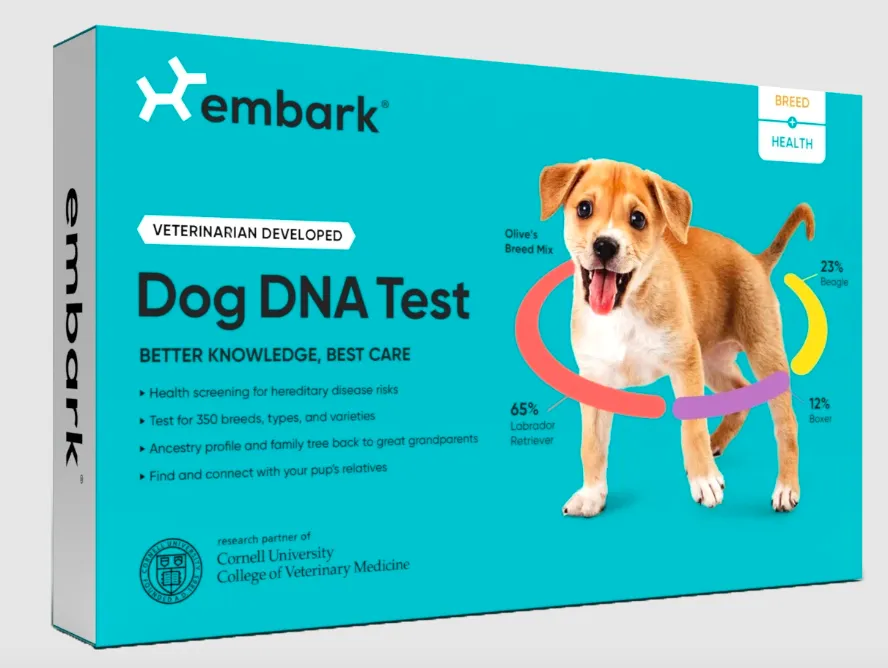
Photo of the Embark DNA test kit
Best Overall

Embark

A premium dog DNA kit known for strong breed detection, health screening, and breeder-grade data depth.

$99 (Breed ID) / $199 (Breed + Health)
Photo of the Wisdom Panel DNA test kit
Best Budget Pick

Wisdom Panel

A popular dog DNA kit for breed detection, ancestry breakdowns, and breed-related trait insights.

$100 (Essential) / $160 (Premium)

Five dog DNA tests are worth comparing in 2026. Embark is the best overall pick for breed-and-health depth, Wisdom Panel is the strongest value, Basepaws is the right call if you already use the platform for a cat, DNA My Dog is the budget breed-only option, and Orivet fits owners who want trait and condition reports from a dedicated veterinary genetics lab.

Before the picks, one calibration: dog DNA tests do not “identify” your dog’s breeds the way a fingerprint identifies a person. They compare your dog’s DNA against a company-built reference database and report the most likely breed composition with confidence intervals. Two reputable kits can return different breed mixes for the same dog, and those differences can reflect reference panels, algorithms, and reporting thresholds, but they can also reflect weak performance by a particular service, so any single breed call is best read as an estimate rather than a definitive label.

Key takeaways

Here is the short version before the detail.

  • Best overall: Embark Breed + Health Kit: 400+ breeds in the reference database, 270+ health markers, results in 2 to 4 weeks, $159 to $349
  • Best value: Wisdom Panel Premium: 365+ breeds, 265+ health markers, results in 2 to 3 weeks, $99 to $159
  • Cat-and-dog household: Basepaws Dog DNA Test: 330+ breeds, 280+ health markers, results in 4 to 6 weeks, $149 list (frequently on sale near $88)
  • Budget breed-only: DNA My Dog Essential: breed composition without health screening, around 3-week turnaround, ~$65 to $85
  • Vet-lab provenance: Orivet Geno Pet / Genopet VET+ / Canine HealthCheck: breed and trait reports from a veterinary genetics lab, ~$139, 2 to 5 weeks
  • Core health panels mostly screen single-gene variants, but some current kits layer in proprietary statistical risk or behavior scores. Embark publishes allergy risk scores and a mast-cell-tumor risk estimate; Wisdom Panel reports behavior and weight-predisposition insights. Treat those scores as non-diagnostic risk estimates, not predictions or diagnoses.
  • No dog DNA test replaces veterinary care. Treat flagged results as risk markers, not diagnoses.

The full comparison matrix follows the explainer below, so you can read the table after you know what each column is actually measuring.

How dog DNA tests actually work

Every consumer dog DNA test does roughly the same four things, and understanding the mechanics changes how you read the results.

1. The lab reads a small slice of your dog’s genome. You collect a cheek-swab sample and mail it in. The lab runs the DNA on a SNP microarray chip that reads tens to hundreds of thousands of single-nucleotide positions known to vary between dogs. Basepaws uses next-generation sequencing instead, which reads longer stretches of DNA. Either approach samples a tiny, deliberately chosen fraction of the roughly 2.4 billion base pairs in a dog’s genome, and whole-genome sequencing does not automatically produce more accurate breed calls. Accuracy depends on the reference database, not sequencing depth alone.

2. Your dog’s SNP profile is compared to a breed-reference panel. Each company has built its own database of purebred and known-mix dogs, with each breed represented by a panel of reference samples. The algorithm asks, statistically, which combination of reference breeds best explains the SNPs in your dog’s sample. The output is a probability distribution across breeds, not a fingerprint match. UC Davis School of Veterinary Medicine describes pet breed-ID tests this way: they report the closest matches to a company-specific database, not a definitive breed assignment.

3. Breed results are probabilistic and depend on the panel. When a kit reports your dog is 38% Labrador Retriever, that figure is the best-fit probability given the markers tested and the breeds in that company’s reference panel. Rarer or regionally underrepresented breeds may be lumped into broader categories if the reference database doesn’t include them. The breed-call threshold (typically 5 to 10 percent) sets how small a fraction the kit will report. A 2024 JAVMA analysis summarized by University of Colorado Anschutz researchers used registered purebred dogs (not mixed-breeds) and still found meaningful variability between brands. At one extreme, a service returned a registered purebred Beagle as 50% Poodle, 50% Bichon Frisé, and 0% Beagle. Differences between brands can reflect reference panels, algorithms, and reporting thresholds, but they can also reflect weak performance from a particular service, so any single breed call should be read cautiously.

4. Health screening checks a defined list of variants, plus, on some kits, proprietary risk and behavior scores. Marketing numbers like “270+ health risks” or “265+ health tests” mostly refer to single-gene variants in specific genes: MDR1 for drug sensitivity, SOD1 for degenerative myelopathy risk, vWF for von Willebrand disease, the variant linked to exercise-induced collapse, and so on. For those, a single variant drives most of the risk. Some current kits layer in additional non-diagnostic scores calculated from many variants combined with breed ancestry: Embark’s Breed + Health and Purebred kits publish allergy risk scores and an ancestry-based mast-cell-tumor risk estimate, and Wisdom Panel describes behavior and weight-predisposition insights built from complex statistical models. The companies themselves frame these as non-diagnostic estimates, not clinical predictions, and they sit alongside (not inside) the single-gene panels. Validated clinical-grade tests for hip dysplasia, most cancers, and allergy diagnosis still sit outside mainstream consumer kits today, although the polygenic landscape is moving; a new genetic test for canine cruciate ligament risk has been reported in veterinary news.

For the single-gene results, a positive finding is a risk marker, not a diagnosis. Penetrance varies: a dog with two copies of the SOD1 variant has elevated DM risk but may never develop the disease. Cornell’s Riney Canine Health Center frames a positive finding as something to discuss with your vet, not act on alone.

Comparison matrix

FeatureEmbark Breed + HealthWisdom Panel PremiumBasepaws Dog DNADNA My Dog EssentialOrivet Geno Pet / Genopet VET+ / Canine HealthCheck
List price (May 2026)$159–$349$99–$159$149 (often ~$88 on sale)~$65–$85$139
Breeds in reference database400+365+330+350+365+ breeds/varieties (Genopet breed-ID products); Canine HealthCheck is primarily a purebred disease/trait screen
Single-gene health markers270+ single-gene variants265+ (Premium); 25+ (Essential)280+ across 12 disease categoriesNone on Essential320+ diseases + 50+ traits (Canine HealthCheck)
Proprietary statistical risk / behavior scoresAllergy risk scores + ancestry-based MCT risk estimate (non-diagnostic)Behavior and weight-predisposition insights (non-diagnostic)Not clearly marketed as broad complex-disease predictionNot includedWeight / LifePlan and breeder-relevance tools; not a broad complex-disease predictor
Genetic-diversity contextYes (Embark Premium)Yes (Wisdom Panel Premium; heterozygosity / genetic diversity)NoNoVaries by SKU / breeder workflow
Relative finder / DNA matchingYesYes (per current product page)NoNoNo
Sample typeCheek swabCheek swabCheek swabCheek swabCheek swab
Lab approachSNP microarraySNP microarrayNext-generation sequencingSNP-based breed arraySNP panel (vet genetics lab)
Results timeline2–4 weeks2–3 weeks4–6 weeks~3 weeks2–5 weeks
Breeder use caseEmbark for Breeders (separate SKU)Wisdom Panel Premium / Optimal SelectionLimitedLimitedStrong: vet-lab provenance
Best forBreed depth + health detailStrong value across breed and healthMulti-pet households on BasepawsLowest-cost breed-only resultVet-verified trait and disease reports

Mainstream dog DNA kits screen selected single-gene variants for known inherited conditions and, in some cases, layer in proprietary non-diagnostic risk or behavior scores. They should not be read as broad clinical predictors of complex-disease risks like most cancers, behavior diagnoses, or orthopedic disease unless a specific validated clinical test is named.
Our top picks

Each entry leads with verified 2026 specifications from the manufacturer’s current product page (accessed May 20, 2026), then the editorial verdict.

Embark Breed + Health Kit

SpecValue (May 2026)
Price$159 (Breed + Health) to $349 (Premium with diversity score)
Breed reference database400+ breeds, types, and varieties
Single-gene health markers270+
Proprietary risk scoresAllergy risk scores; ancestry-based MCT risk estimate (non-diagnostic)
Sample typeCheek swab
Lab approachSNP microarray (~230,000+ markers)
Results timeline2 to 4 weeks
Relative finderYes
Genetic-diversity scoreYes (with Premium add-on)

Embark compares your dog’s DNA against a reference database of more than 400 breeds and reports the most likely breed composition with confidence intervals. Its health panel screens for over 270 single-gene variants, including MDR1 drug sensitivity, exercise-induced collapse, and the SOD1 variant linked to degenerative myelopathy. Alongside those single-gene tests, Embark publishes proprietary allergy risk scores and an ancestry-based mast-cell-tumor risk estimate, both framed by the company as non-diagnostic. The Premium add-on layers in a genetic-diversity score and access to a relative-finder network that connects your dog to others in Embark’s database.

Embark publishes more validation data than any other consumer dog DNA company and is the kit most commonly cited in veterinary literature. It is the strongest single purchase if you adopted a mixed-breed dog and want the deepest breed and health detail consumer kits can offer.

Wisdom Panel Premium

SpecValue (May 2026)
Price$99 (Essential) to $159 (Premium)
Breed reference database365+ breeds
Single-gene health markers265+ (Premium); 25+ (Essential)
Proprietary risk / behavior scoresBehavior and weight-predisposition insights (non-diagnostic)
Sample typeCheek swab
Lab approachSNP microarray (Mars Petcare in-house lab)
Results timeline2 to 3 weeks
Relative finderYes (added to both tiers per current product page)
Genetic-diversity scoreYes, on Premium ancestry reporting (heterozygosity / genetic diversity)

Wisdom Panel compares your dog’s DNA against a reference database of 365+ breeds and reports the most likely breed composition. The Essential plan ($99) returns breed composition, 25+ health markers, and relative matching; the Premium plan ($159) expands single-gene screening to 265+ variants and adds Wisdom Panel’s behavior and weight-predisposition insights, built from complex statistical models the company describes as non-diagnostic. Premium also reports heterozygosity / genetic diversity as part of its ancestry section. Wisdom Panel’s current product page lists relative matching across tiers, which earlier versions of this article missed.

Turnaround runs slightly faster than Embark, the fastest in this comparison. This kit fits owners who want strong breed estimation plus solid health screening without paying for Embark’s deepest tier.

Basepaws Dog DNA Test

SpecValue (May 2026)
Price$149 list; $87.99 current sale on product page
Breed reference database330+ breeds
Single-gene health markers280+ across 12 disease categories
Proprietary risk scoresNot clearly marketed as broad complex-disease prediction
Sample typeCheek swab
Lab approachNext-generation sequencing (Zoetis lab)
Results timeline4 to 6 weeks
Relative finderNo
Genetic-diversity scoreNo

Basepaws built its reputation on cat DNA and is now part of Zoetis, an animal health company. Its dog kit uses next-generation sequencing rather than the microarray chips Embark and Wisdom Panel run, which reads more of the genome per sample. The result set covers a 330+ breed reference database and 280+ single-gene health markers.

The tradeoff is track record. Embark and Wisdom Panel have longer publication histories on their canine pipelines, and Basepaws’s dog product is comparatively new. The WGS approach is scientifically legitimate, but breed-call accuracy still depends on the reference database, not sequencing depth alone. The kit fits best if you already use Basepaws for a cat and want both pets on one dashboard, or if the current sale price brings the multi-pet bundle below the competition.

DNA My Dog Essential

SpecValue (May 2026)
Price~$65 to $85
Breed reference database350+ breeds (per current product page)
Single-gene health markersNone on the Essential kit
Proprietary risk scoresNot included
Sample typeCheek swab
Lab approachSNP-based breed array
Results timeline~3 weeks
Relative finderNo
Genetic-diversity scoreNo

DNA My Dog is the lowest-cost entry on this list. The Essential kit returns a breed composition estimate against a 350+ breed reference database; it does not include single-gene health screening at the base price. The company sells add-on allergy and condition tests as separate SKUs.

DNA My Dog fits owners whose primary question is what breeds is my dog? and who want a budget-priced answer. Anyone who needs health-marker screening should look at Embark, Wisdom Panel Premium, Basepaws, or Orivet instead. No KYD editorial walk-through of this kit is on file, and the company does not yet have an affiliate link in our system; the manufacturer site is the purchase path.

Orivet Geno Pet / Genopet VET+ / Canine HealthCheck

SpecValue (May 2026)
Price$139 (Geno Pet or Canine HealthCheck tier)
Breed reference database365+ breeds/varieties for Genopet breed-ID products; Canine HealthCheck is primarily a purebred disease/trait screen
Single-gene health markers320+ diseases and 50+ traits (Canine HealthCheck)
Proprietary risk scoresWeight / LifePlan and breeder-relevance tools; not a broad complex-disease predictor
Sample typeCheek swab
Lab approachVeterinary genetics lab
Results timeline2 to 5 weeks after sample arrival at the lab
Relative finderNo
Genetic-diversity scoreVaries by SKU / breeder workflow

Orivet runs out of a veterinary genetics laboratory, which gives its reports a different provenance from the consumer-marketing brands. Orivet’s Geno Pet line (including Genopet VET and Genopet VET+) is the breed-identification product, drawing on a 365+ breed/variety reference set and bundling breed detection with disease screening and LifePlan recommendations. The Canine HealthCheck SKU is built around 320+ disease variants and 50+ trait markers and is positioned for purebred or breeder workflows where targeted disease screening matters more than a mixed-breed composition report. Orivet’s Full Breed Profile is the breed-specific purebred screen: it returns tests relevant to the selected breed rather than a generic mixed-breed composition. The health report formatting is designed for veterinary and breeder use, with clinical summaries built for discussion with a vet or breed association.

Orivet appeals to owners who want vet-lab sourcing on the report and to breeders who already work with veterinary genetics labs. No KYD editorial walk-through of this kit is on file, and no affiliate link is in our system; the manufacturer site is the purchase path.

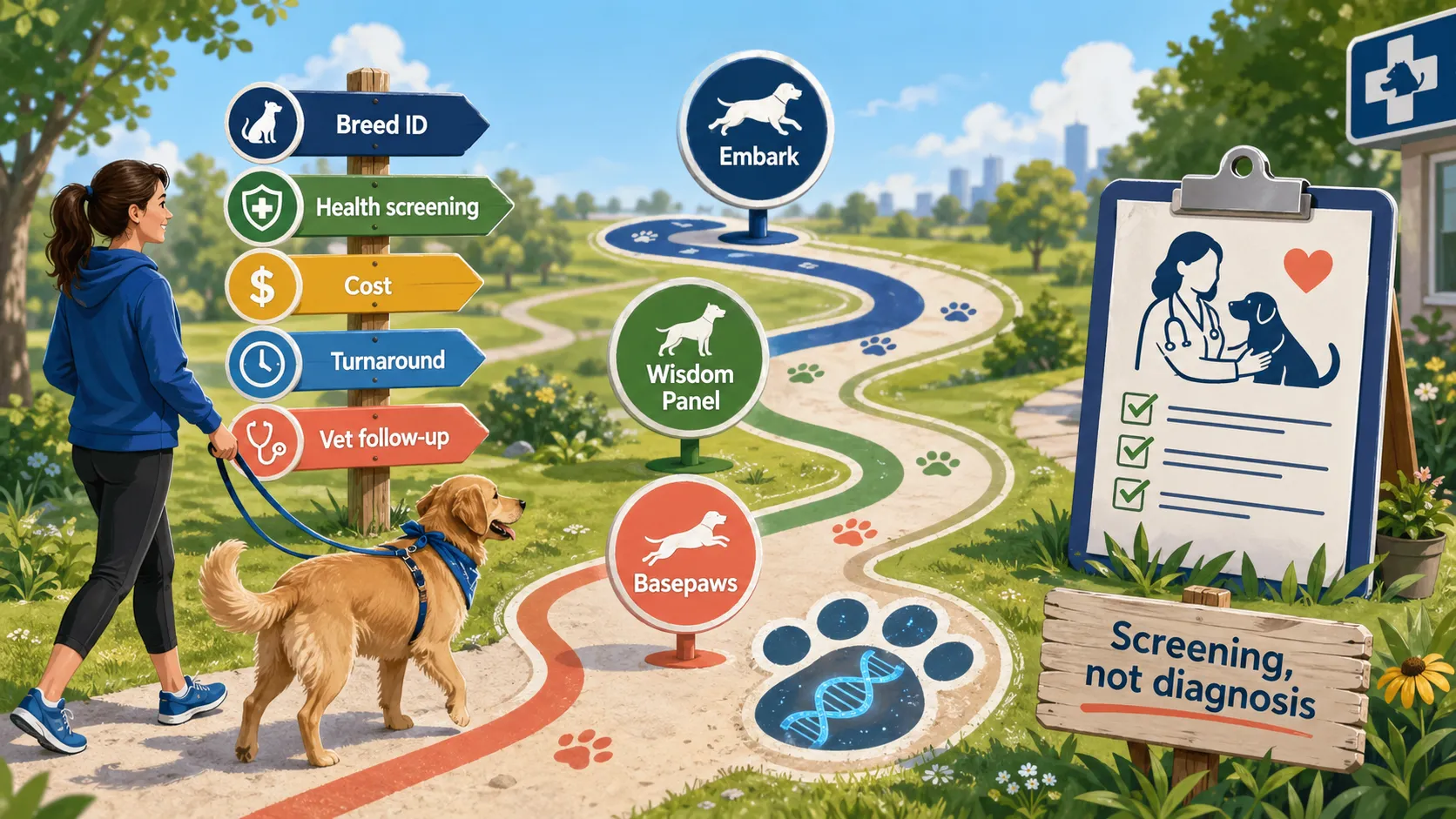
Dog DNA test decision trail showing breed ID, health screening, cost, turnaround, vet follow-up, and Embark, Wisdom Panel, Basepaws, DNA My Dog, and Orivet decision points.

How to choose between them

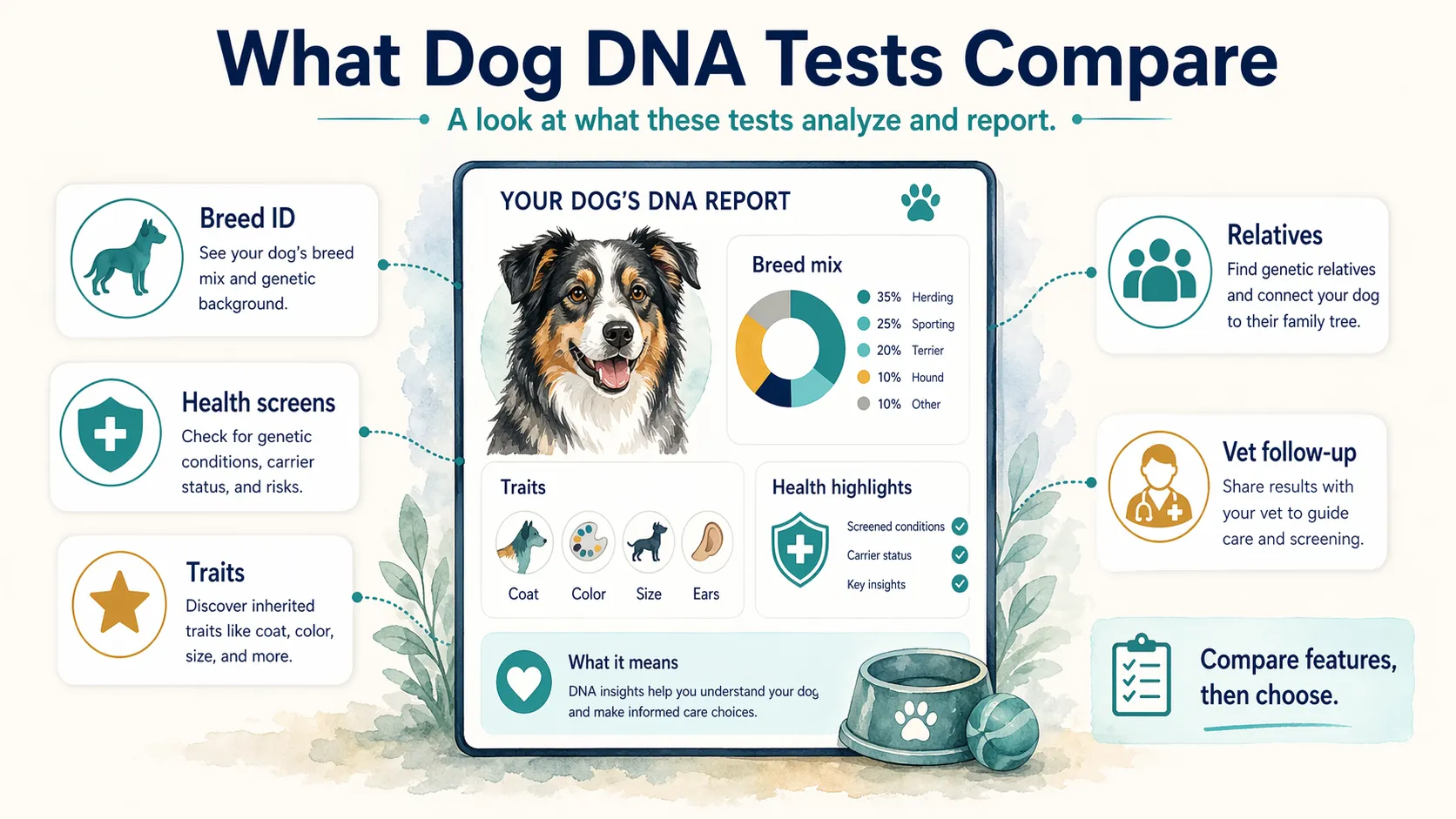
Dog DNA explainer showing core features to compare, including breed ID, health screens, traits, relatives, and vet follow-up.
Compare dog DNA tests by the features you need, not just by the product name.

The decision depends on what you want the result to do.

If health context matters most, pick Embark, Wisdom Panel Premium, or Orivet Canine HealthCheck. All three screen 250+ single-gene variants. Embark layers in a genetic-diversity score plus its allergy and MCT risk estimates; Wisdom Panel Premium adds heterozygosity reporting and behavior insights. Those statistical scores are useful conversation starters with a vet, not standalone diagnoses.

If breed estimation is the main goal, Wisdom Panel Essential at $99 returns a 365+ breed composition plus limited health screening and relative matching. DNA My Dog at around $65 to $85 is the budget option if you don’t want any health markers at all.

If you already use Basepaws for a cat, the Basepaws dog kit keeps both pets on one platform. Use the current sale price as your gate: at the $87.99 sale the value calculus tilts strongly toward Basepaws; at $149 list it sits middle of the pack.

If you want a vet-lab pipeline or you’re making breeding decisions, Orivet is the most distinctive option here, and its Canine HealthCheck SKU carries the highest single-gene disease-marker count at $139. Embark for Breeders is a separate SKU built for professional breeders, with parentage verification and stud-dog matching.

If budget is the deciding factor, Wisdom Panel Essential and DNA My Dog occupy the value floor. Embark discounts regularly around holidays, sometimes dropping the Breed + Health kit below $130; checking all five brands during a sale stretches your budget further than committing to one upfront.

No kit replaces a veterinary exam. Cornell’s College of Veterinary Medicine and UC Davis both describe genetic test results as inputs to a veterinary conversation, not substitutes for one, especially before any medical or breeding decision.

How to use these results with your vet

Dog DNA results are most useful as context for a clinical conversation. Three single-gene flags are worth raising with your vet whenever they show up on a kit report, plus a breed-composition follow-up.

MDR1 status changes drug selection. A positive MDR1 (also called ABCB1) result affects P-glycoprotein, a drug-transport protein that normally keeps certain drugs out of sensitive tissues including the brain. When that transporter is impaired, drugs such as ivermectin, loperamide, some sedatives, and certain chemotherapy agents can accumulate and cause toxicity. UC Davis and AAHA materials describe how this directly informs pre-anesthetic and preventive-medication choices, and even one-copy dogs can show a milder version of the sensitivity.

von Willebrand factor status changes surgical planning. A dog reported as at risk or affected for a vWF variant may have reduced clotting ability and a higher bleeding risk during procedures like spay/neuter. Cornell’s Riney Canine Health Center notes that vWD is confirmed with a blood test, and that depending on genotype, breed, and clinical signs, your vet may recommend vWF-level testing before surgery, especially for carriers, where the DNA result alone doesn’t tell you how much clotting factor your dog is actually producing.

SOD1 (degenerative myelopathy) status changes late-life mobility planning. Two copies of the SOD1 variant elevate DM risk, though many at-risk dogs never develop clinical signs. The OMIA database describes incomplete penetrance: meaning a positive result is a long-horizon planning prompt, not a near-term diagnosis.

Breed composition can change preventive screening. Some breeds carry elevated risk for specific structural or cardiac conditions (DCM in Dobermans, brachycephalic airway syndrome in Bulldogs and French Bulldogs, urate stones in Dalmatians). A breed-composition result (even for a mixed-breed dog) is a starting point for earlier breed-specific screening discussions, not a diagnostic.

Take the result PDF to your next routine appointment. A peer-reviewed canine genetic-testing quality checklist in Human Genetics notes that confirming a positive variant through an accredited lab is appropriate before any irreversible decision.

Common questions about dog DNA tests

What is the most accurate dog DNA test?

There is no single “most accurate” dog DNA test: accuracy depends on what you’re measuring. For breed composition, Embark and Wisdom Panel both run the largest reference databases (400+ and 365+ breeds respectively) and Embark uses the highest-density SNP array in the category (~230,000+ markers). Embark also publishes the most validation data and is the kit most commonly cited in independent veterinary research. For single-gene health-marker screening, the variant assays are similar across major kits; what differs is which conditions each kit includes. The 2024 JAVMA study used registered purebred dogs (not mixed-breeds) and still found meaningful between-company variability, underscoring why both purebred and mixed-breed breed calls should be read as estimates rather than definitive labels.

Are dog DNA tests worth it?

Worth it depends on the question. If you want breed clarity for a mixed-breed adoption: yes, a $99 to $159 kit reliably returns a composition estimate that helps you understand size, exercise, and grooming needs. If you want actionable health context, a kit with single-gene screening (Embark, Wisdom Panel Premium, Basepaws, Orivet Canine HealthCheck) can surface MDR1, vWF, and SOD1 status before those become surgical or drug-selection problems. If you want broad clinical prediction for complex disease (hip dysplasia, most cancers, allergy diagnosis, or obesity diagnosis), current consumer kits cannot provide that, although some now report proprietary non-diagnostic risk or behavior scores for selected traits.

How accurate is Embark vs Wisdom Panel?

Both kits compare your dog’s DNA against curated breed-reference databases and report probabilistic compositions. Embark uses a 230,000+ SNP microarray and a 400+ breed panel; Wisdom Panel uses a similar microarray approach on a 365+ breed panel. Independent comparisons typically find their major-breed calls agree, with more variation on small-fraction breeds and on rare or recently-developed breeds. The 2024 JAVMA review summarized by University of Colorado Anschutz used registered purebred dogs and still surfaced meaningful between-company variability: at one extreme, a service returned a registered purebred Beagle as 50% Poodle, 50% Bichon Frisé, and 0% Beagle. Neither kit is “more accurate” in a categorical sense, but breed calls from any single service should be read cautiously.

Can a DNA test tell me what breeds my dog is?

Yes, with confidence intervals. A dog DNA test compares your dog’s SNP profile to a company-built reference database of purebred and known-mix samples, then reports the breed combination that best explains your dog’s DNA statistically. The result is a probability distribution with a reporting threshold (usually 5 to 10 percent), not a definitive ID. The same dog tested with two different brands can return slightly different breed mixes, and the differences may reflect reference panels, algorithms, and reporting thresholds, or weak performance from a particular service. Accuracy is higher for dogs with a large percentage of a single recognized breed and lower for dogs with many small-percentage ancestry segments.

The bottom line

Embark remains the best dog DNA test for owners who want the deepest breed and health data in one kit, including its allergy and MCT risk scores. Wisdom Panel Premium is the better buy if you want strong breed estimation, solid single-gene screening, behavior insights, and heterozygosity reporting at a lower price point. Basepaws is worth a look if you already use the platform for a cat or if its sale pricing makes the multi-pet bundle compelling. DNA My Dog is the budget breed-only entry. Orivet fits owners who want vet-lab provenance and the broadest single-tier disease-screening panel on this list.

Read every result as a probabilistic estimate, not a verdict. Take the single-gene flags to your next vet appointment, and remember that proprietary risk and behavior scores are conversation starters, not diagnoses. For more on what a dog DNA kit will actually cost across these tiers, see the dog DNA test cost guide.

How We Made These Picks

We use the same standards across our guides so you can compare products more fairly.

  • Every product is judged on its core use case first, not just marketing claims.
  • We compare database size, report depth, privacy practices, price, and real-world fit.
  • We favor products with a clear reason to exist over kits that overlap without adding value.
  • These recommendations are updated as features, pricing, and category leaders change.

Updated May 20, 2026

13 sources cited

Updated on May 20, 2026

  1. 1.
    What Genetic Testing Can and Can't Tell You About Your Pet. UC Davis School of Veterinary Medicine. https://synergy.vetmed.ucdavis.edu/news-article-spring-2023/what-genetic-testing-can-and-cant-tell-you-about-your-pet
  2. 2.
    Benefits of Canine DNA Testing. Cornell University College of Veterinary Medicine, Riney Canine Health Center. https://www.vet.cornell.edu/departments-centers-and-institutes/riney-canine-health-center/canine-health-topics/benefits-canine-dna-testing
  3. 3.
    CU Data Scientists Find Flaws With Dog DNA-Testing Companies. University of Colorado Anschutz School of Medicine. https://medschool.cuanschutz.edu/deans-office/cu-med-today/profilesarchives/cu-data-scientists-review-dog-dna-companies
  4. 4.
    Genetic Testing: An Expanding Frontier. American Animal Hospital Association, Trends Magazine. https://www.aaha.org/trends-magazine/publications/genetic-testing-an-expanding-frontier/
  5. 5.
    Shaffer LG, et al. Quality Assurance Checklist and Additional Considerations for Canine Clinical Genetic Testing Laboratories. Human Genetics (2019). https://link.springer.com/article/10.1007/s00439-019-02013-9
  6. 6.
    Multidrug Sensitivity (MDR1/ABCB1). UC Davis Veterinary Genetics Laboratory. https://vgl.ucdavis.edu/test/multidrug-sensitivity-mdr1
  7. 7.
    Von Willebrand Disease. Cornell University College of Veterinary Medicine, Riney Canine Health Center. https://www.vet.cornell.edu/departments-centers-and-institutes/riney-canine-health-center/canine-health-topics/von-willebrand-disease
  8. 8.
    Degenerative Myelopathy in Canis lupus familiaris (OMIA:000263-9615). Online Mendelian Inheritance in Animals. https://omia.org/OMIA000263/9615/
  9. 9.
    The Science Behind Allergy Risk Scores. Embark Veterinary. https://embarkvet.com/resources/allergy-risk-scores/
  10. 10.
    Compare Embark Tests Product Page (accessed May 20, 2026). Embark Veterinary. https://embarkvet.com/compare/
  11. 11.
    Dog DNA Tests Product Page (accessed May 20, 2026). Wisdom Panel. https://www.wisdompanel.com/en-us/dog-dna-tests
  12. 12.
    Basepaws Dog DNA Test Product Page (accessed May 20, 2026). Basepaws / Zoetis. https://basepaws.com/products/basepaws-dog-dna-test
  13. 13.
    Orivet Pet Owner and Canine HealthCheck Product Pages (accessed May 20, 2026). Orivet Genetic Pet Care. https://www.orivet.com/pet-owner
Katrina Canlas

Written by

Katrina Canlas

KC Canlas is an experienced content writer for Know Your DNA. She combines her passion for storytelling with a deep understanding of DNA and genetics....