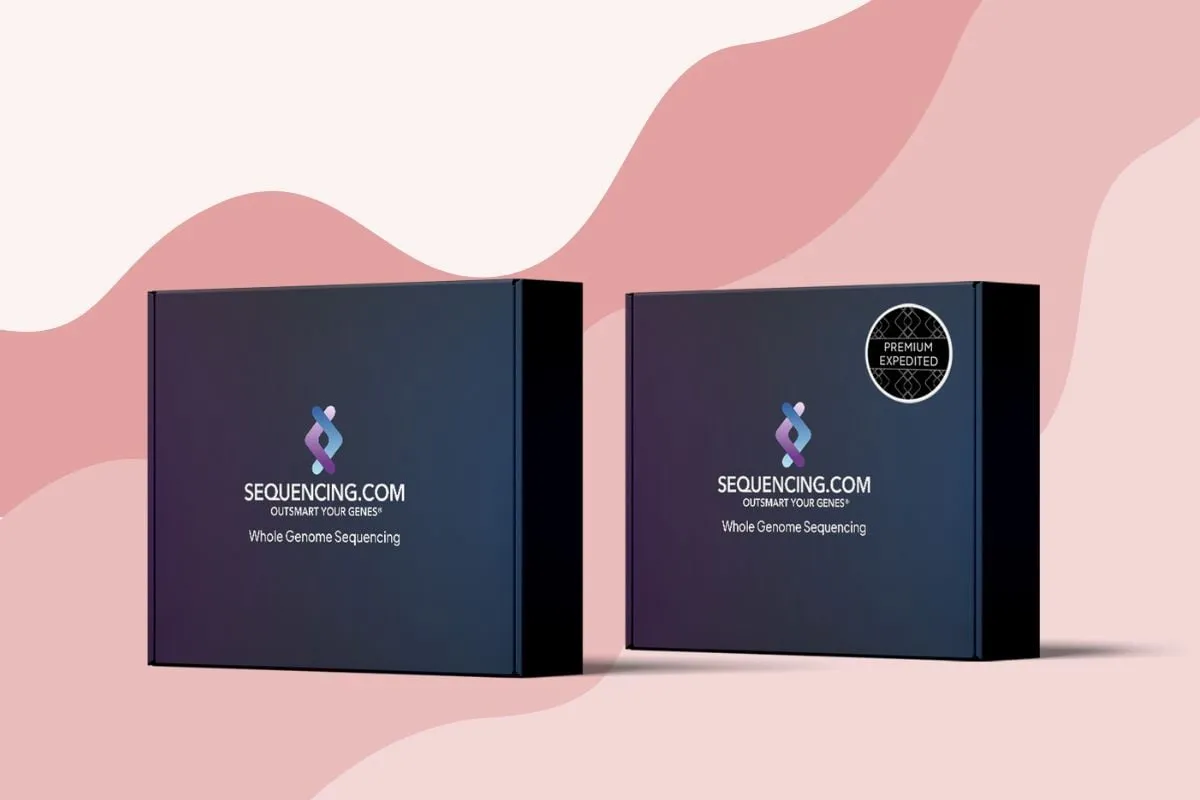

Sequencing.com sells 30x whole genome sequencing for around $399, a kit that reads roughly 3 billion base-pair positions per chromosome copy rather than the ~650,000 SNPs a 23andMe-style chip samples. That single fact should drive whether this product is right for you.
If you only want ancestry percentages or a friendly health-trait dashboard, a SNP-chip kit is cheaper and easier. If you want genome-depth data (rare variants, pharmacogenomic exploration, long-term reanalysis), Sequencing.com is one of a small group of consumer-priced ways to get it. If you arrived here after looking at Nebula Genomics, read the Nebula section first: the picture has changed.
Key Takeaways
- Sequencing.com is legit. It delivers a real 30x whole genome product with raw files in standard formats; most complaints trace to per-app interpretation costs on top of the kit price, not fraud.
- 30x whole genome sequencing runs around $399. The kit reads the entire genome rather than the 100,000 to 1 million markers a SNP chip samples.
- The app marketplace lists 20+ analysis tools. Free apps cover ancestry and traits; paid health, pharmacogenomic, and carrier-status apps typically cost $5 to $99 each.
- Sequencing.com accepts uploads from 23andMe, AncestryDNA, MyHeritage, and FamilyTreeDNA. You can use the marketplace without buying their sequencing kit.
- Raw files are large. A compressed VCF is about 5 to 10 GB; the full BAM or CRAM is closer to 100 to 200 GB.
- Consumer DNA results are not diagnoses. The FDA warns that DTC results should not drive medical decisions without confirmatory clinical testing.
- If you were watching Nebula: Nebula’s legacy consumer service was not shut down; it appears to have transitioned into DNA Complete by Nebula Genomics, which is currently selling 1x, 30x, and 100x whole genome products. Compare both product pages before assuming Sequencing.com is the only operating option.
Whole Genome Sequencing vs SNP Chips
Whole genome sequencing (WGS) reads nearly every position in your DNA. A SNP-chip test (the kind 23andMe and AncestryDNA sell) samples a few hundred thousand pre-selected spots and infers the rest. That gap is what you are paying for.
MedlinePlus Genetics defines WGS as a method that reads nearly all the roughly 3 billion DNA building blocks in a person’s genome. NHGRI puts the human genome at about 3 billion base pairs per haploid copy, or about 6 billion across the two chromosome copies most people carry. Chip-based DTC tests use arrays that NHGRI says commonly include 100,000 to 1 million markers, a small fraction of the genome.
| Feature | SNP-Chip Tests (23andMe, AncestryDNA) | 30x Whole Genome (Sequencing.com) |
|---|---|---|
| Positions read | ~650,000 to ~1 million pre-selected SNPs | ~3 billion positions per haploid copy |
| Variant classes detected | Common SNPs at known locations | SNPs, small insertions and deletions, and some structural and copy-number variants |
| Rare-variant coverage | Limited; most rare variants are not on the chip | Broader, though coverage and calling depend on the analysis pipeline |
| Raw-file size | Tens of MB | ~5 to 10 GB compressed VCF; ~100 to 200 GB for the full BAM or CRAM alignment |
| Reanalysis as science grows | Locked to the markers the chip measured | Re-runnable against new databases later |
| Typical price (2026) | $99 to $229 | Around $399 for 30x; verify current pricing before purchase |
A 30x label means each position is read on average 30 times. Higher coverage supports more confident variant calls, especially for indels and structural variants. NHGRI’s clinician FAQ warns that third-party interpretation of raw DTC data produces false positives and should be confirmed clinically before any health decision, and MedlinePlus cautions that the significance of many WGS findings remains unknown. More data does not automatically mean more clarity.
A SNP chip gives you a curated snapshot. WGS gives you the underlying file. They are not equivalent.
If You Were Looking at Nebula Genomics
Nebula Genomics is not what it was a year ago, but it is not gone. The legacy Nebula consumer experience appears to have transitioned into DNA Complete by Nebula Genomics, which is currently selling 1x, 30x, and 100x whole genome products through the Nebula site. Before treating Sequencing.com as the automatic replacement, pull up the current DNA Complete product page alongside the Sequencing.com kit on the day you intend to buy.
For most buyers, the practical comparison now looks like this:
- 30x whole genome sequencing at a consumer price. Sequencing.com’s core kit and Nebula’s 30x DNA Complete tier both sit in that band. Pricing, promotional bundles, and what each company includes by default change often; check both pages directly.
- Raw-file ownership. Sequencing.com gives you the underlying genome file. Nebula’s earlier consumer pitch was built around the same idea; verify whether the current DNA Complete product still delivers raw files in the format you need.
- Interpretation layer. Sequencing.com runs an app marketplace. Nebula’s earlier model leaned on a curated report library plus optional reanalysis. Check what DNA Complete now bundles versus what costs extra.
What is genuinely different:
- Nebula’s blockchain-style data-access controls. Nebula’s earlier pitch leaned on a cryptographic access-log model that let users approve queries against their data. We have not verified whether DNA Complete still markets that mechanism; check the current Nebula product and privacy pages directly if that architecture is your reason to buy. Sequencing.com uses a conventional consent-and-deletion model (see Privacy Model below).
- Relative matching. Neither service is built for genealogy. If matching is your goal, AncestryDNA is the better fit.
If you have a stored Nebula genome file from the legacy service, you can typically upload it to a third-party platform for further analysis, but verify your data-export window with Nebula before assuming the file is still retrievable from the old system.
Our Verdict
Sequencing.com is the right buy if you understand why whole genome data matters and accept that interpretation is a separate task. At about $399, the 30x kit undercuts most clinical whole genome sequencing by a wide margin while delivering raw files you keep.
The product is not built for first-time DNA buyers. The marketplace asks you to choose, install, and trust individual apps rather than read one tidy report. 23andMe delivers a smoother health-plus-ancestry experience. Sequencing.com fits buyers who have outgrown chip-based testing, are weighing it against the current Nebula DNA Complete lineup, or need genome files for downstream research and clinician follow-up.
Is Sequencing.com Legit?
Sequencing.com is a legitimate whole genome sequencing provider, not a scam. The company sells a real 30x WGS product, delivers your data in the standard bioinformatics formats clinical and research pipelines use (FASTQ, BAM/CRAM, VCF), and posts a privacy policy with a documented deletion workflow, which we accessed on May 20, 2026. A fraud operation does not hand you a 100-plus-gigabyte alignment file of your own genome.
Why does the legitimacy question rank so high in search? Three honest friction points generate most of the complaints:
- The total cost is higher than the sticker price. The $399 kit is the entry point; meaningful health analysis usually means paid apps at $5 to $99 each, and historical subscription tiers add renewal terms people miss. Buyers who expected one tidy report for $399 feel upsold. The Pricing and Total Cost of Ownership section below itemizes this.
- App quality varies by design. The marketplace model pushes quality-control onto the buyer. NHGRI’s clinician FAQ flags that third-party raw-data interpretation is inconsistent — a structural caveat of every app-marketplace model, not evidence of bad faith.
- Results are not clinical. The FDA warns that direct-to-consumer results should not drive medical decisions without confirmatory testing. People expecting diagnostic answers feel shortchanged; that expectation gap fuels negative reviews across the entire consumer-genomics category.
One verification we recommend before buying: confirm the current sequencing partner lab and its CAP/CLIA accreditation status on the product page. Those details have shifted over the product’s history, and the privacy policy references CLIA/CAP retention obligations without naming the current lab. That is a transparency gap worth checking, not a disqualifier.
Net: legit company, real product, honest caveats — budget for the apps, not just the kit.
What You Get
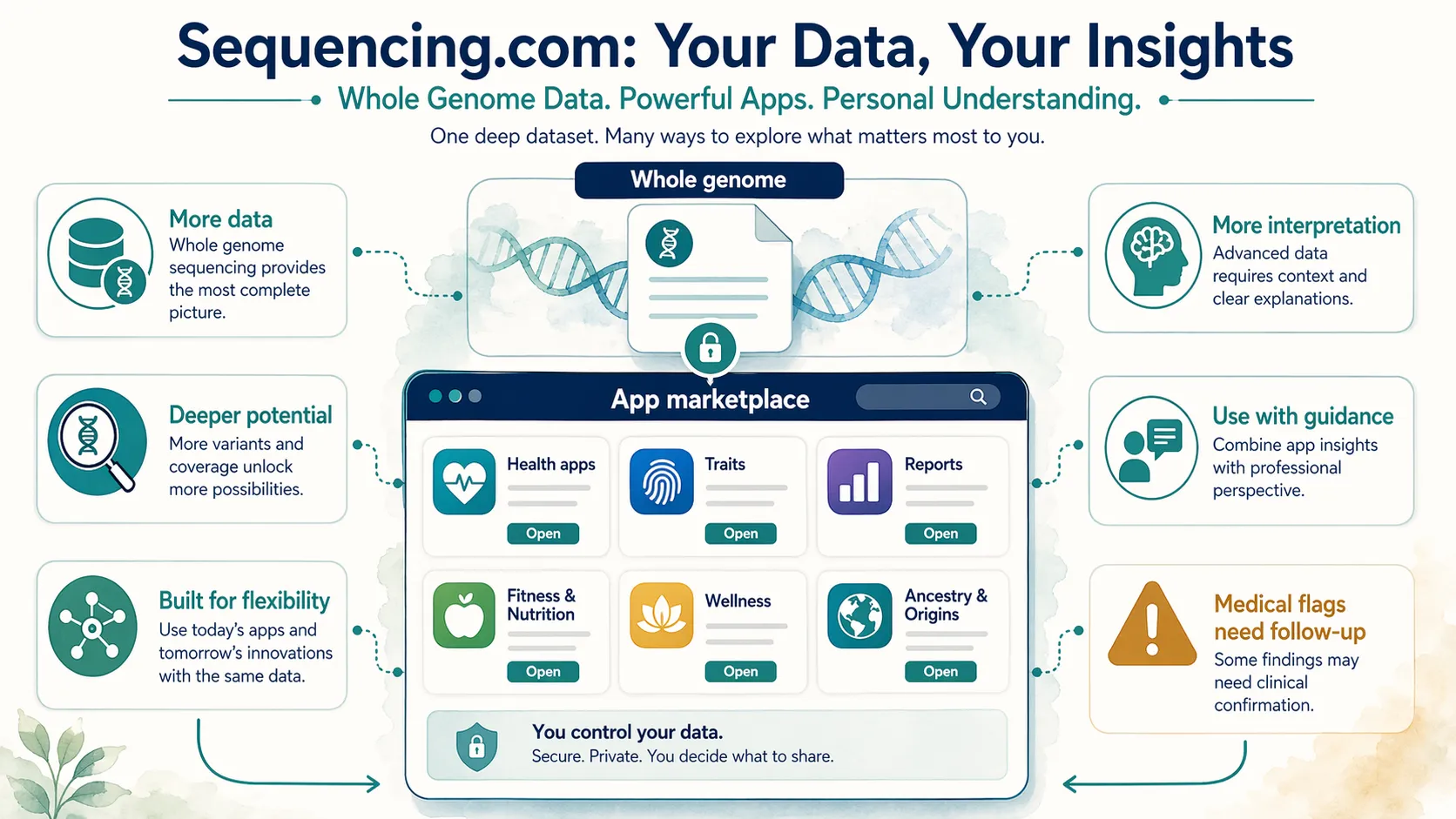
Sequencing.com bundles two things: a sequencing product and an app marketplace that interprets the data.
The 30x Whole Genome Kit
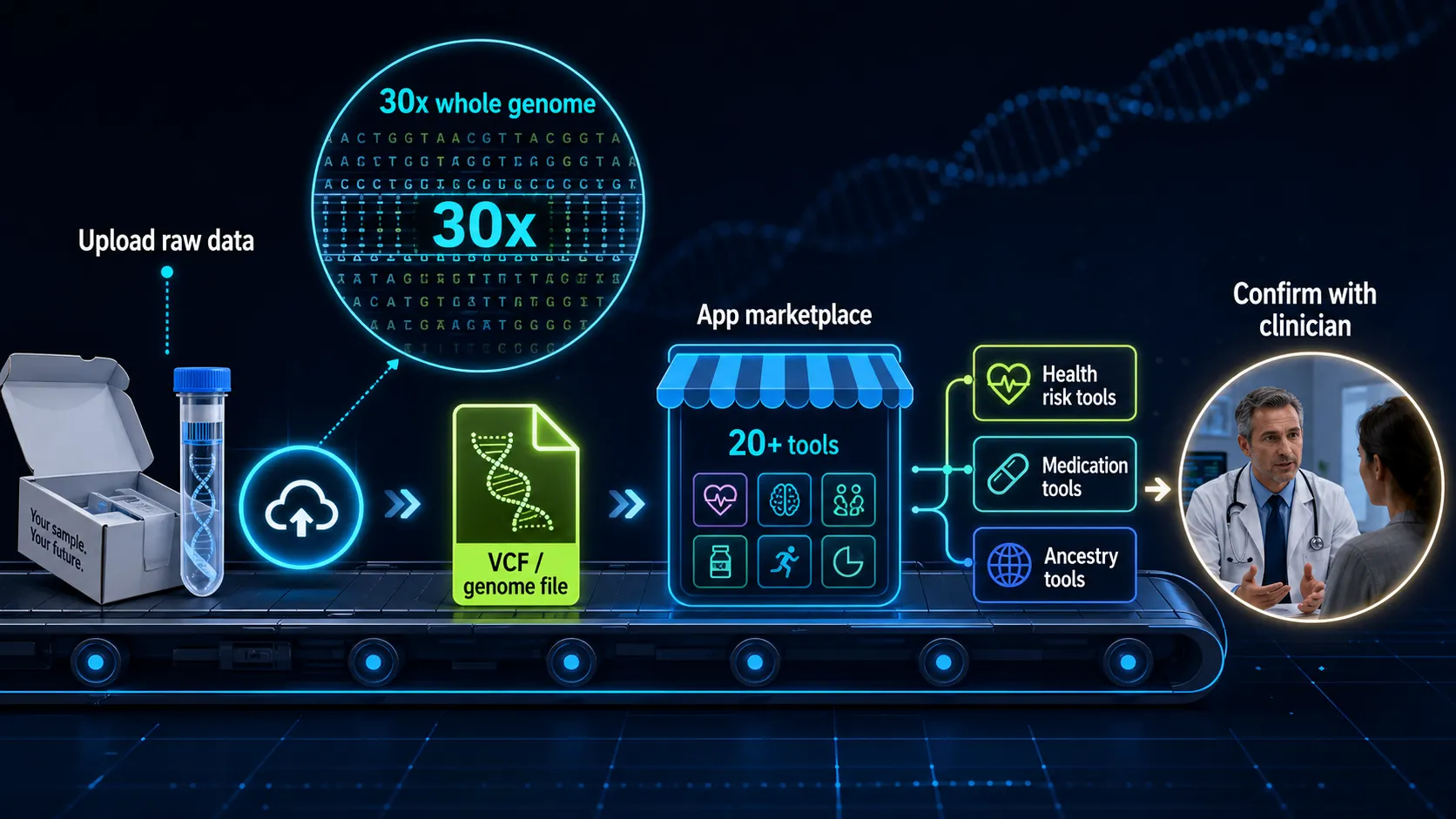
The core kit sequences your genome at approximately 30x average coverage via a DNA collection kit you receive in the mail and return for lab processing. Verify the current sample-collection method, sequencing partner lab, and the lab’s CAP and CLIA accreditation status on the Sequencing.com product page before buying. Those details have shifted over the product’s history, and the privacy policy references CLIA/CAP retention obligations without naming the current partner lab directly.
GeneReviews notes that 30x WGS can support detection of many variant types SNP arrays do not assay (rare SNVs, small insertions and deletions, and some structural or copy-number variants), though detection depends on the lab’s pipeline and the variant. Coverage alone does not determine interpretation quality.
Raw-File Formats and Sizes
Sequencing.com offers downloads in standard bioinformatics formats: FASTQ (raw sequencer reads), BAM or CRAM (aligned reads), and VCF (called variants). Sizes vary by format:
- VCF (compressed): roughly 5 to 10 GB. Contains the variant calls and is the most portable.
- BAM or CRAM: roughly 100 to 200 GB. The aligned read data that bioinformatics tools and clinical reanalysis pipelines need.
- FASTQ: large, used mostly for re-aligning the genome against a different reference.
Plan for cloud download time and local storage. An external drive is a reasonable purchase if you want to keep a permanent BAM or CRAM.
The App Marketplace
Instead of one fixed report set, Sequencing.com runs an app marketplace with free and paid options. The platform lists 20+ apps across ancestry, traits, health risk, fitness, nutrition, carrier-status exploration, and pharmacogenomics. Free apps cover the basics; paid apps typically cost $5 to $99 each.
This gives experienced users flexibility. It also pushes the quality-control decision onto the buyer: you choose which apps to trust, and rigor varies across the marketplace. NHGRI’s clinician FAQ flags that third-party raw-data interpretation is inconsistent and should not drive medical decisions on its own.
Upload Compatibility
Sequencing.com accepts raw-data uploads from 23andMe, AncestryDNA, MyHeritage, FamilyTreeDNA, and other major providers, which is useful if you already have chip-based raw data and want broader interpretation options. Verify current accepted sources and any upload fees on the product page. For more on what to do with raw files from any provider, see our raw data guide.
Sequencing.com vs Dante Labs vs Full Genomes
The right comparison set for a Sequencing.com shopper is not 23andMe; it is the small group of consumer-WGS providers still operating in 2026. Pricing, depth, and lab certification shift; verify each row on the provider’s own site before buying.
| Provider | Coverage Depth | Approximate Price (2026) | Raw-File Delivery | Interpretation Layer |
|---|---|---|---|---|
| Sequencing.com | 30x WGS | Starting around $399 | FASTQ, BAM/CRAM, VCF | App marketplace with 20+ free and paid apps |
| Dante Labs | 30x WGS, with higher-coverage tiers historically offered | Check current site (not verified for 2026) | FASTQ, BAM, VCF | Bundled health and trait reports plus raw-data access |
| Full Genomes | 30x WGS plus optional higher-coverage tiers (60x and above) | Check current site (not verified for 2026) | FASTQ, BAM, VCF | Research-oriented; fewer consumer-facing reports |
Pricing and lab certification for Dante Labs and Full Genomes were not independently verified for this editorial cycle. The deep-research pass confirmed both are operating in 2026 but did not surface dated pricing from their current product pages. Treat those rows as a starting point and confirm directly on each company’s site. Where a provider does not publicly disclose CAP or CLIA status, treat health-related claims with extra caution.
Clinical-grade options (Color, Variantyx, and similar services ordered through a physician) offer CLIA-certified sequencing with clinical report delivery and counseling integration, typically $1,000 and up. Consumer WGS is not a substitute for clinical diagnostic sequencing when the indication is medical.
Use Cases That Benefit From WGS, and When SNP Chips Are Enough
WGS is worth the price for some specific goals and overkill for others. Match your reason for buying against the lists below before paying for depth you will not use.
When WGS Pays Off
- Carrier-status exploration, not clinical carrier screening. WGS reads more of the genome than a known-variant SNP chip, which matters for ancestry groups underrepresented in chip reference panels. Treat this as exploration, not a substitute for a validated clinical carrier-screening test. ACOG’s guidance is clear that real reproductive decisions should rest on a clinical carrier screen with partner testing and a genetic counselor in the loop when results call for it.
- Pharmacogenomic exploration. WGS gives you broader sequence data than a chip’s handful of CYP enzymes, but it does not automatically translate to medication guidance. Useful PGx interpretation depends on validated gene-drug associations, accurate calling of complex genes like CYP2D6 (which has a pseudogene and common structural variants that trip up consumer pipelines), and clinical confirmation. The FDA’s table of pharmacogenetic associations is not comprehensive, and the FDA is explicit that DTC pharmacogenomic results should not be used to start, stop, or change medication without a prescriber and confirmatory clinical testing. If medication guidance is the actual goal, a dedicated PGx test like ClarityX is built for that purpose, with a clinician reviewing the report, for around $399 list and self-pay only since it is not billed to insurance. The evidence that PGx-guided prescribing improves how patients actually feel, rather than just what gets prescribed, is still mixed, so it earns you a better-informed conversation with a prescriber, not a guaranteed answer.
- Long-term reanalysis. ClinGen notes that variant classifications change as new evidence accumulates. A stored genome file can be reanalyzed years later.
- Pre-clinical investigation of unexplained symptoms. A WGS file is useful information to bring to a genetic counselor, though it is not a substitute for clinical sequencing ordered by a physician.
When a SNP Chip Is Enough
- Ancestry percentages and ethnicity estimates. SNP chips were built for this and are the cost-efficient choice.
- Common-variant trait reports (eye color, taste, sleep traits).
- Mainstream chip-based health reports for selected, well-studied variants: APOE status and the selected BRCA1/2 variants in 23andMe’s FDA-authorized/cleared reports (the original De Novo–authorized founder-variant report plus the later 510(k)-cleared selected-variant expansion). These are useful for curiosity or a first-pass risk discussion, not a diagnosis, and they do not replace clinical testing when personal or family history points there. The FDA also notes that the listed variants do not represent the majority of BRCA1/2 variants in most ethnicities, and a negative result does not rule out other cancer-risk variants.
- Relative matching and family trees. AncestryDNA’s 25+ million-user matching database is the strongest in this category.
If your buying reason lives entirely in the second list, save the $200 to $300 difference and start with a chip-based kit; our 23andMe review is a good first stop.
A quick note on MTHFR: common-variant MTHFR testing shows up on a lot of DTC dashboards, but ACMG’s practice guideline and SMFM’s Choosing Wisely guidance both say MTHFR polymorphism testing has minimal clinical utility and should not be ordered as part of a thrombophilia workup. Treat it as a curiosity readout, not a health marker, and skip the supplement upsells that ride on it.
Variants of Uncertain Significance: What to Expect
A whole genome scan will surface variants the lab cannot confidently classify as harmful or benign. These are called variants of uncertain significance, or VUS. Buyers coming from chip-based tests are rarely warned about this and tend to panic at “clinical impact unknown” on a report.
The ACMG/AMP variant-classification framework (the standard most clinical labs use) defines five categories: pathogenic, likely pathogenic, uncertain significance, likely benign, and benign. A VUS sits in the middle because the evidence is not strong enough to call it either way. In a full genome read, a meaningful share of flagged variants fall in the VUS bucket, especially in genes with limited published research.
Two practical implications:
- A VUS is not a diagnosis. It is a flag for follow-up, not a finding to act on. The FDA’s DTC-test guidance specifically warns that positive consumer results do not guarantee disease.
- Reclassification is normal. ClinGen notes that variant interpretations can change over time. A VUS in 2026 may become “likely benign” or “likely pathogenic” by 2029; saving your genome file is what makes that future reanalysis possible.
App-marketplace health reports use third-party variant databases, so report quality depends on which databases each app queries and how current their classifications are. If a Sequencing.com app flags a VUS in a gene that matters clinically (BRCA1/2, the Lynch syndrome genes, cardiomyopathy genes), bring the call to a board-certified genetic counselor before drawing conclusions. The National Society of Genetic Counselors directory is the standard starting point.
Reports vs Research Access: What You Can Actually Do With the Data
Two layers sit on top of your genome file, and they serve different buyers.
The reports layer is what most customers use. You install an app from the marketplace, point it at your genome, and get a structured report covering ancestry, traits, pharmacogenomic exploration, and health risks. Convenient, but constrained by each app’s analysis quality.
The research-access layer is the raw file. With a BAM or VCF in hand, you can run third-party tools like Promethease, hand the file to a bioinformatician, or upload to community projects. This layer has no real ceiling, but it requires expertise most consumers do not have.
A realistic ceiling for a non-bioinformatician is the reports layer plus light use of established third-party tools. The full research workflow is open to you, but expect a steep learning curve and no Sequencing.com support for what happens outside the marketplace. NHGRI also warns that third-party raw-data interpretation produces false positives and should be clinically confirmed before any health decision.
Pricing, Total Cost of Ownership, and Subscription Quirks
The 30x kit runs around $399 as of May 2026. Verify current pricing on the Sequencing.com site; promotional pricing and bundle composition shift. For a broader market view, see our genetic testing cost guide.
The kit price is only part of the spend. Sequencing.com layers optional subscriptions and per-app costs on top:
- Kit purchase: $399 for 30x WGS, give or take promo pricing. One-time cost.
- Free apps: ancestry, basic traits, some health overviews. No cost.
- Paid apps: typically $5 to $99 each. Pharmacogenomic, carrier-status, and disease-risk apps cluster at the higher end.
- Optional subscription tiers: Sequencing.com has historically offered premium or professional plans that bundle apps and reanalysis features. Verify active subscription terms (renewal cadence, cancellation policy) on the product page before buying.
A realistic 12-month total for a buyer who runs three to five paid apps lands around $450 to $700 (kit plus a typical app basket). Power users can spend more.
Privacy Model
Sequencing.com’s privacy model is conventional: encryption at rest and in transit, account-level access controls, user-controlled data-sharing settings, and an explicit deletion-request workflow. We accessed the policy on May 20, 2026; review it directly before uploading or sequencing, especially if whole-genome data retention concerns you.
Nebula’s earlier pitch leaned on a blockchain-style mechanism that logged and gated each query against a user’s data, a technology layer that made unauthorized access structurally difficult rather than just contractually prohibited. Whether the current DNA Complete by Nebula Genomics product still markets that architecture is worth confirming on the current Nebula site if data-access logging is part of why you are buying. Sequencing.com itself uses the conventional model: a posted policy, account controls, and a deletion-request workflow.
If your reason to consider Nebula was specifically its cryptographic access-log story, do not assume Sequencing.com is a one-to-one replacement on that dimension. For most buyers, the practical question is whether you trust the company’s data-handling commitments and whether you understand which third-party apps receive access to your data. Review app-specific permissions before connecting any app. For a broader look, see our privacy guide.
Pros and Cons
Pros
- Deepest consumer-priced data. 30x WGS covers variant classes chip-based tests do not assay.
- Flexible marketplace. Pay only for the analyses you want, starting at $0.
- Upload-friendly. Existing raw data from 23andMe, AncestryDNA, MyHeritage, and FamilyTreeDNA works at no sequencing cost.
- Long-term data value. Genome files remain useful as variant databases improve.
- Mature WGS-plus-marketplace option. A working alternative to weigh against the current Nebula DNA Complete lineup.
Cons
- Steeper learning curve. You navigate apps individually and judge quality yourself.
- Interpretation costs add up. Meaningful health analysis often runs $10 to $99 per app on top of the kit.
- Not built for genealogy. Relative matching and family trees are not part of the platform.
- VUS exposure. A full genome read will surface variants of uncertain significance; know this before running health apps.
- Health findings are not clinical. The FDA warns DTC results should not drive medical decisions without confirmatory testing.
Who It Is Best For
Sequencing.com fits buyers who already understand why WGS matters (rare-variant exploration, pharmacogenomic depth as a starting point for clinical follow-up, long-term data ownership, or comparison-shopping against Nebula’s current DNA Complete tiers) and who accept that interpretation is a multi-step process. At about $399, it undercuts most clinical 30x sequencing by a wide margin.
It also works as a second step for experienced DNA-testing users. If you tested with 23andMe or AncestryDNA and want deeper analysis, the upload path lets you explore the marketplace without retesting.
It is the wrong product if you want a fast, one-dashboard answer to “what is my ancestry?” or “what health risks should I know about?” Mainstream chip-based kits handle those questions faster and more cheaply. It is also the wrong choice if your main goal is finding relatives; AncestryDNA’s matching database is built for that.
The Bottom Line
We recommend Sequencing.com for buyers who want whole genome depth and are comfortable assembling their own analysis workflow. The combination of 30x sequencing at about $399, a flexible app marketplace, raw-file ownership, and upload compatibility from major SNP-chip providers makes it one of the most accessible consumer WGS platforms in 2026, alongside DNA Complete by Nebula Genomics, which is worth pricing on the same day you check Sequencing.com.
If you want simpler health-plus-ancestry reporting, start with our 23andMe review. For guided health analysis without managing apps yourself, read our SelfDecode review. If your main question is what to do with raw DNA data from any provider, our raw data guide is the better next step. And if Sequencing.com surfaces anything that looks medically meaningful, follow up with a board-certified genetic counselor before acting on it.