

Mongolian spots are flat, bluish-gray birthmarks that usually appear on the lower back or buttocks of newborns. They are common in babies of Asian, Native American, Hispanic, East Indian, and African descent. The medical name is congenital dermal melanocytosis.
These marks are harmless and almost always fade by adolescence. We explain what causes them, how common they are, and what the cultural stories behind them mean.
How Common They Are
Mongolian spots are among the most common birthmarks in the world, but their prevalence varies sharply by ancestry.
| Population | Estimated Prevalence |
|---|---|
| East Asian | 80%-100% of newborns |
| Native American | 85%-100% |
| African and Afro-Caribbean | 80%-96% |
| Hispanic | 46%-70% |
| South Asian | 60%-72% |
| Caucasian / European | 1%-10% |
If your baby has a Mongolian spot and you have Asian, African, Indigenous, or Hispanic heritage, the mark is entirely expected. Even among European-descent babies, it occurs occasionally and is no cause for concern.
What Causes Them
Mongolian spots form during fetal development when melanocytes, the cells that produce skin pigment, get trapped in the deeper layers of skin called the dermis. In most skin, melanocytes sit near the surface in the epidermis. When they remain deeper, the overlying skin filters their color into a bluish-gray tone.
This is the same optical effect that makes veins look blue through your skin. The pigment itself is brown, but the depth changes how your eyes perceive the color.
As a child grows, the trapped melanocytes gradually break down or migrate to the surface. That is why most Mongolian spots fade significantly by age 3 to 5 and disappear entirely by adolescence. In rare cases, spots persist into adulthood, but they remain harmless.
Myths and Beliefs From Around the World
Different cultures have developed their own explanations for these distinctive marks. Here are some of the most well-known.
- Chinese tradition sometimes refers to the spot as a mark left when a deity gives the baby a pat to send it into the world.
- Mongolian belief treats the birthmark as a heavenly seal, reflecting the patronage of the eternal blue sky over the child.
- Korean mythology describes the spot as a bruise left by Samshin Halmi, a shaman spirit who slaps the baby’s back to hasten birth.
- Maya tradition in the Yucatan Peninsula calls it “Wa,” meaning the circle of heaven.
- Kyrgyz belief sees the spot as a sign of protection from evil and a guarantee of life.
- Turkic peoples, including the Uighurs, believe the mark comes from Tengri, the sky deity, or Umai-ene, a protective spirit who blesses the newborn.
These stories reflect how universally common Mongolian spots are in the populations that tell them. A birthmark that appears on nearly every baby naturally becomes part of the cultural origin narrative.
How to Tell Them Apart From Other Marks
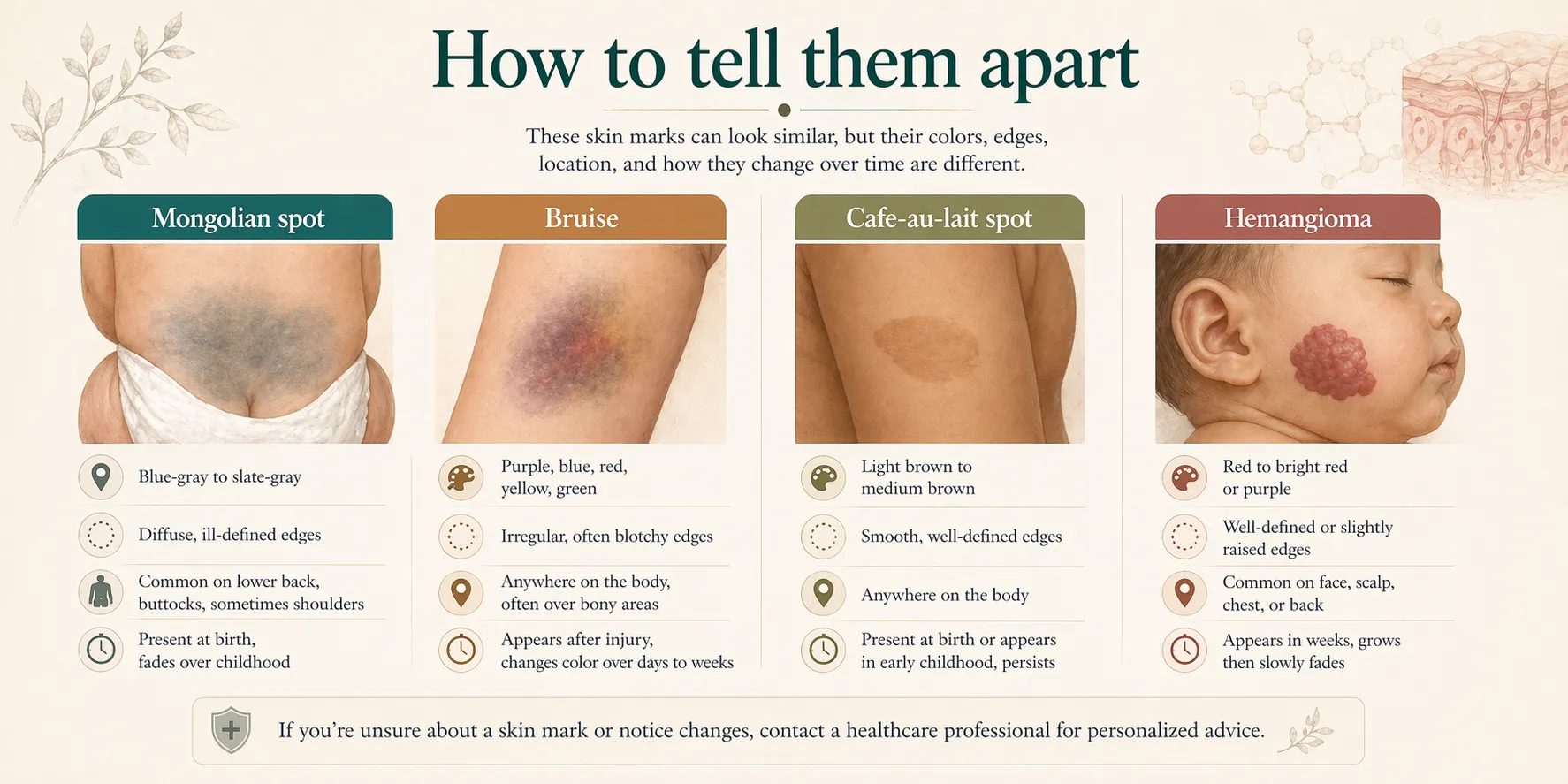
Mongolian spots are sometimes confused with bruises, which can create unnecessary alarm for parents or even inappropriate reports of abuse. Knowing the differences matters.
- Mongolian spots are present at birth or appear within the first few weeks. They have uniform color, smooth borders, and do not change in response to pressure. They do not hurt the baby.
- Bruises change color over days, often have irregular borders, and are tender to the touch.
- Café-au-lait spots are light brown, not blue-gray, and do not fade with age. Multiple café-au-lait spots can sometimes signal a genetic condition like neurofibromatosis.
- Hemangiomas are raised, red or purple, and grow during the first year of life before gradually shrinking.
If you are ever unsure whether a mark on your baby is a Mongolian spot, your pediatrician can confirm it with a visual exam. No special testing is needed.
A Note on Terminology
The term “Mongolian spot” is falling out of use in medical literature because of its ethnic association. The preferred term is now congenital dermal melanocytosis. We use both here because many people still search for the older name, but the medical community increasingly favors the neutral term.
The Bottom Line
Mongolian spots are a normal, harmless birthmark caused by pigment cells sitting deeper in the skin than usual. They are very common in babies of Asian, African, Indigenous, and Hispanic descent. Nearly all of them fade by adolescence.
If you have questions about a birthmark on your child, your pediatrician can help. For more on how genetics shapes physical traits, you can explore our guides on skin color genes and eye color genetics.