

The least genetically diverse populations are the most isolated ones. North Sentinel Island ranks at the extreme, while Iceland, Finland, French Canadians in Quebec, and Ashkenazi Jews are the most commonly cited examples among larger groups. Low diversity almost always traces back to geographic isolation or a population bottleneck, where everyone descends from a small founding group.
Genetic diversity is not the same as ethnic or cultural diversity. Researchers infer population-level genetic diversity from sampled variants, ancestry patterns, and population history; there is no complete country-by-country genetic ranking. The examples below are best read as well-documented isolated or bottlenecked populations, not a fixed league table.
Here is the quick ranking, from most isolated to least:
- North Sentinel Island — near-total isolation, the most extreme case
- Iceland — relatively homogenous, well-documented genealogy
- Finland — historical bottlenecks and distinct “heritage diseases”
- French Canadians (Quebec) — descended from a small group of 17th- and 18th-century settlers
- Ashkenazi Jews — bottlenecks linked to higher rates of certain inherited conditions
Below we explain each example and the forces that shape genetic diversity.
Least Diverse Populations
- North Sentinel Island — This island’s inhabitants have had almost no contact with the outside world, leading to very low genetic diversity. Only isolated Amazonian tribes may have comparable levels.
- Iceland — While not the absolute least diverse, Iceland has a relatively homogenous population. The misconception about an app to prevent dating close relatives highlights this (Note: The app highlights genealogical connections rather than implying widespread inbreeding).
- French Canadians (particularly in Quebec) — Descended primarily from a small group of 17th- and 18th-century French settlers, they have a unique genetic makeup, including a higher risk of Tay-Sachs disease.
- Finland — Historical bottlenecks have led to a concentration of certain “heritage diseases” specific to the Finnish population.
- Ashkenazi Jews — Like French Canadians, historical events have increased their likelihood of carrying Tay-Sachs disease.
Important Considerations
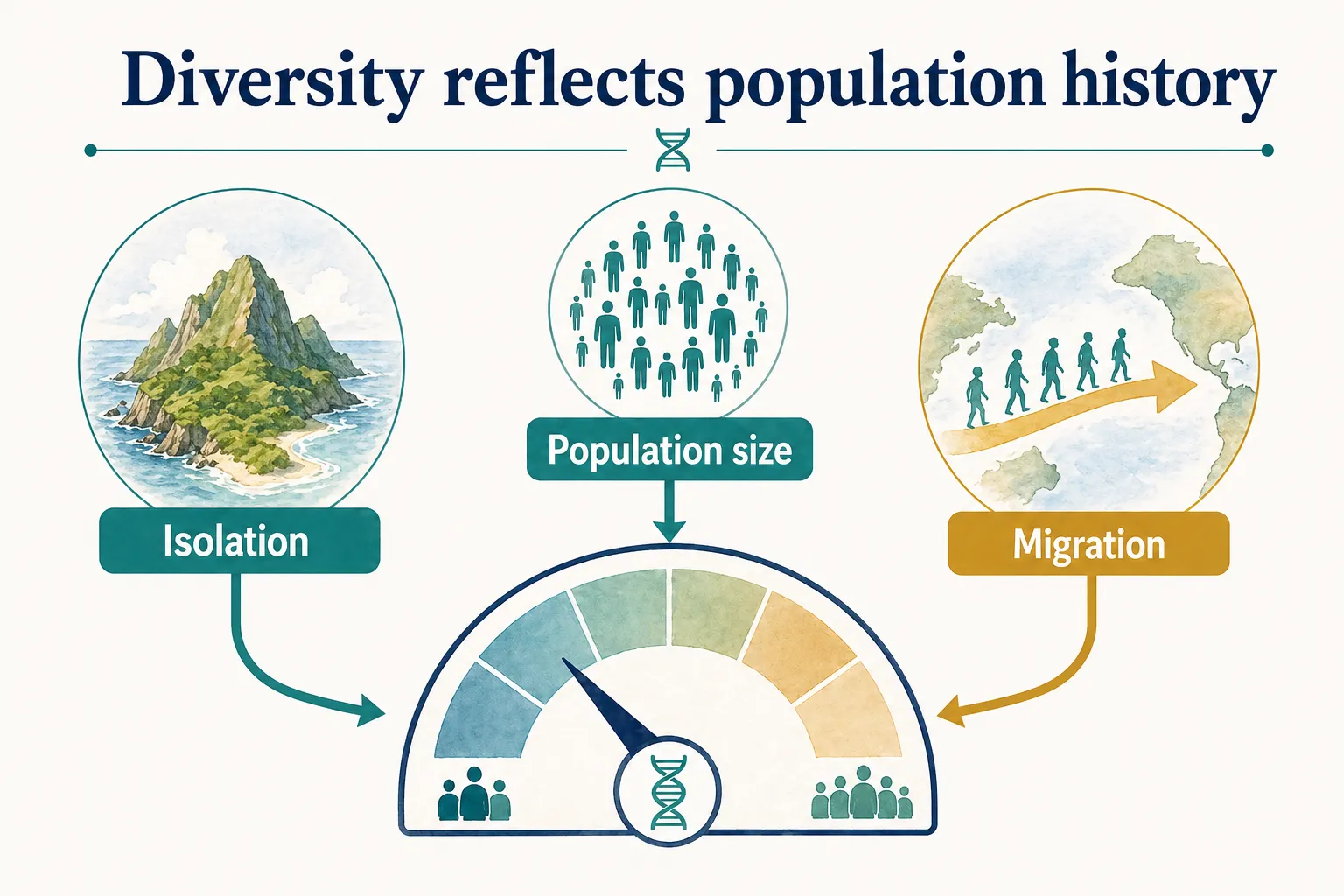
- Factors Influencing Diversity — A population’s genetic diversity depends on factors like historical migration, size, and social practices. Isolation or severe population reductions (bottlenecks) decrease diversity.
- Global Variation — Areas with long histories of migration, like sub-Saharan Africa, are among the world’s most genetically diverse.

6 Factors Contributing to Genetic Diversity in a Population
1. Mutation
Mutations are changes in an organism’s DNA sequence. In programming terms, this is analogous to random errors or intentional changes introduced into code.
Mutations provide the raw material for new variations within a population, similar to how code changes can create new possibilities in software behavior.
2. Genetic Drift
Genetic drift involves random changes in the frequency of different gene versions (alleles) within a population. This is particularly impactful in small populations.
3. Gene Flow (Migration)
The movement of individuals between populations introduces new genes, increasing diversity. When genes from different regions are combined, new possibilities and variations emerge.
4. Natural Selection
The environment favors certain traits, which translates to the survival and increased frequency of the corresponding genes over time. Traits that have consistently proven useful for survival are more likely to be reused and propagated.
5. Nonrandom Mating
When individuals select mates based on certain characteristics, this can either increase (outbreeding) or decrease (inbreeding) genetic diversity within the population.
6. Recombination
During sexual reproduction, chromosomes exchange genetic material (crossing over), creating new allele combinations.
Genetic diversity is a complex topic influenced by a multitude of factors. Understanding the forces that shape diversity within populations is crucial to understanding human evolution, health, and the ability of populations to adapt to change.