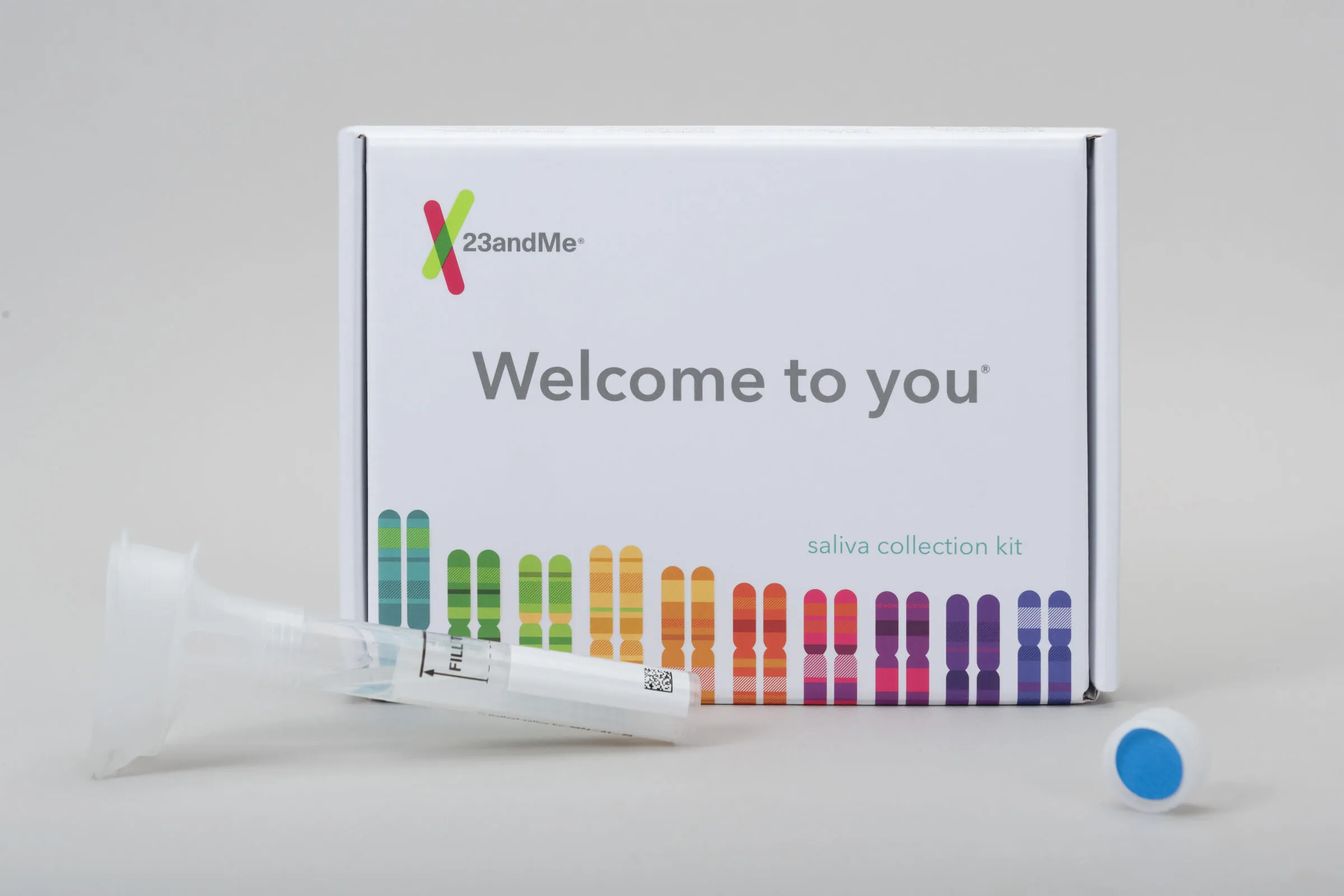

Verdict: ClarityX is a focused, self-pay pharmacogenomic (PGx) test best for patients with a prescribing conversation lined up with a clinician. As of October 2026, Mindwell costs $299.25 and Max Rx $374.25 with ClarityX’s long-running 25% code ($399 and $499 listed). Both genotype the same 39-gene panel, processed at a CLIA-certified, CAP-accredited lab from an at-home cheek swab. If you want medication-response guidance to bring into an appointment, ClarityX is worth a look. If you want ancestry, traits, or a self-prescribing shortcut, it is the wrong product — for wellness and nutrition, ClarityX sells separate Thrive and Clear kits, not covered in depth here.
PGx testing earns its keep when it helps a clinician make a better prescribing call. It is much weaker as a do-it-yourself answer, and the FDA has been explicit that genetic results are one input among many in a prescribing decision. See ClarityX pricing for current checkout figures before you buy.
Key Takeaways
- ClarityX sells four consumer kits: Mindwell and Max Rx for pharmacogenomics, plus Thrive and Clear, separate nutrition/wellness kits not covered by this review.
- October 2026 pricing: Mindwell $299.25 and Max Rx $374.25 with the 25%-off
CLARITY25code, which ClarityX has run under rotating sale names since at least January 2025. The listed prices are $399 and $499. HSA/FSA accepted. - ClarityX says every kit includes a review of your results with your own provider by its pharmacogenomics-certified pharmacists. A one-on-one pharmacist session for you costs extra.
- Mindwell and Max Rx genotype the identical 39 genes. The difference is report scope: Mindwell interprets 120+ mental-health medications, Max Rx interprets 285+ medications across 20+ therapeutic areas. Only a subset of those drugs have actionable FDA pharmacogenomic labeling or CPIC prescribing guidance.
- The panel highlights core CYP450 genes (CYP2D6, CYP2C19, CYP2C9, CYP3A4/5, CYP1A2, CYP2B6) plus high-value non-CYP markers like SLCO1B1, VKORC1, the TPMT/NUDT15 pair, and HLA-B*15:02, several backed by CPIC guidance for specific gene-drug pairs. SLC6A4 is no longer on the published panel.
- ClarityX has no FDA marketing authorization for its test. Like most clinical PGx panels it runs under CLIA rather than as an FDA-cleared device; ClarityX does not publish an explicit “laboratory-developed test” statement, so treat that label as a reasonable inference, not a claim ClarityX makes itself.
- Samples are processed at a CLIA-certified, CAP-accredited lab (ClarityX does not publish the lab’s name, location, or CLIA number). Results are typically available 5–10 business days after lab receipt for Mindwell and Max Rx.
- ClarityX does not accept health insurance, including Medicare, in any form. Medicare’s own PGx coverage rules (NCD 90.1, LCD L39073) apply to clinician-ordered, billed testing generally — they don’t change ClarityX’s self-pay-only posture. Every buyer pays out of pocket.
How ClarityX Works
A PGx test reads specific genetic variants (inherited differences in your DNA) that influence how your body processes or responds to a medication. Some variants slow a drug down, some speed it up, and a few flag a higher side-effect risk. NHGRI and MedlinePlus both note that PGx results are one input alongside health history, lifestyle, and other medications.
Collection is an at-home cheek swab, which ClarityX’s FAQ calls a saliva sample. No clinic visit or blood draw is required; you activate the kit online and mail the sample back in the prepaid packaging. Results are typically available 5–10 business days after the lab receives the sample, with outbound shipping (3–6 business days) on top of that. ClarityX ships to the United States and Canada only.
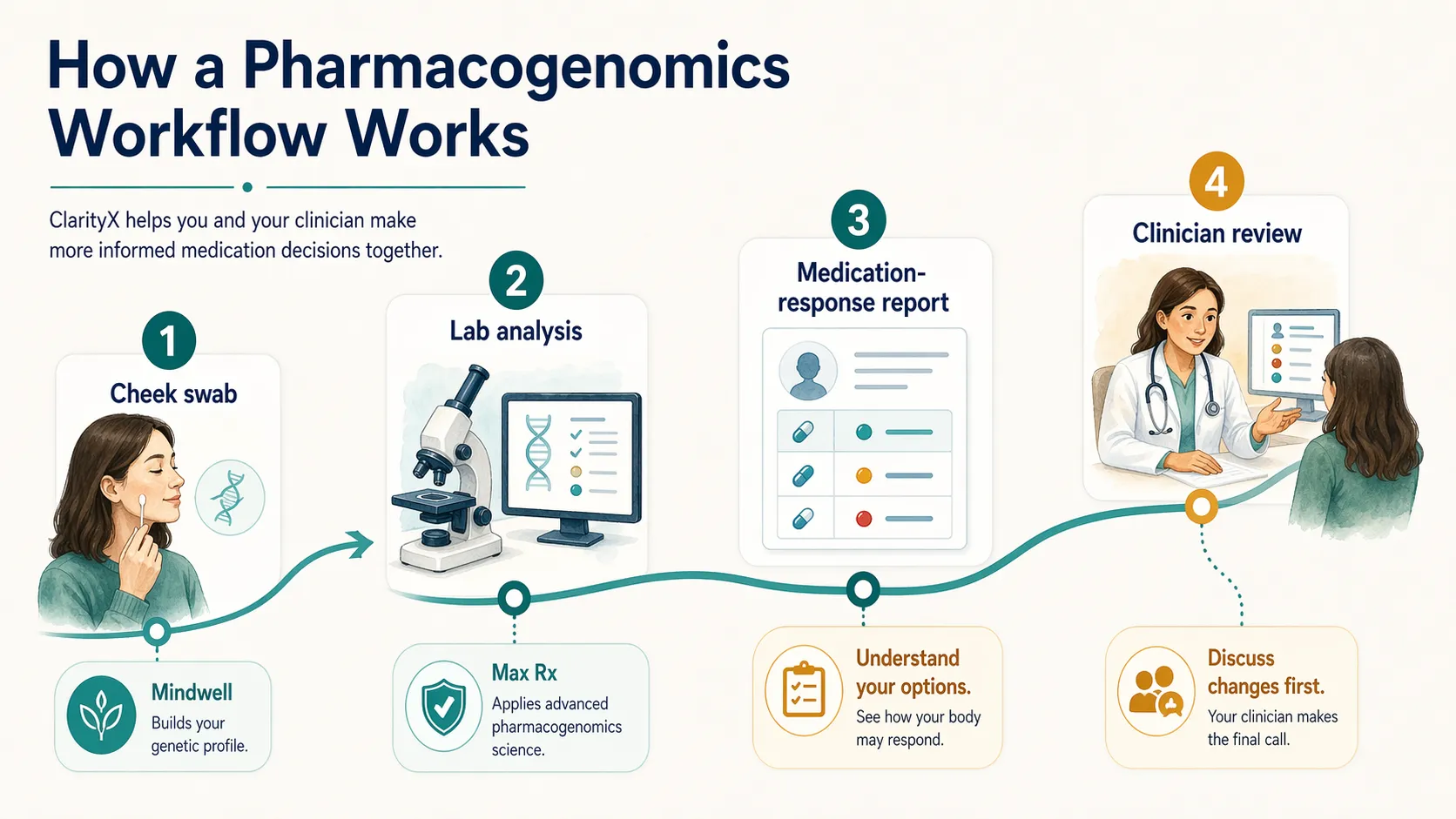
The report is organized around drugs, not genes. For each medication in scope, ClarityX assigns a category (use as directed, use with caution, or consider alternatives) plus dosing guidance and side-effect flags. The value is the prescribing conversation it triggers, not the genotype itself.
ClarityX adds a step before that conversation. Its pharmacists, who are certified in pharmacogenomics, share your report with your provider and consult with them on the results, and your provider then goes over the report with you. ClarityX says this provider review comes with every kit. It only helps if you have a provider to send the report to.
What ClarityX Tests: Genes and Drug Interactions
The most useful question for any PGx test is which genes it reads, and here is the headline finding of this review: Mindwell and Max Rx publish byte-identical “Genes Tested” sections. Both kits genotype the same 39 genes across six categories — drug metabolism (10 genes, including the CYP450 family), transport and clearance (6), response signals for brain/mood/pain (7), safety flags (8), risk management (6), and nutrient processing (2, including MTHFR). The $75 gap between the two kits buys a broader interpretation report — more medications covered — not a bigger panel. ClarityX also lists additional metabolism, transporter, safety, and risk-management genes, including DPYD, NUDT15, HLA-A*31:01, HLA-B*57:01, HLA-B*58:01, MT-RNR1, UGT1A1, CYP2C8, CES1, and NAT2, among others. Confirm the exact gene and variant list in your kit’s sample report before ordering.
CYP450 drug-metabolizing enzymes
- CYP2D6: metabolizes about a quarter of clinically used drugs, including many SSRIs, tricyclics, beta-blockers, opioids, and antipsychotics. Variants can produce poor metabolism (the drug builds up) or ultra-rapid metabolism (the drug clears before it works).
- CYP2C19: relevant to several drugs, including citalopram, escitalopram, sertraline, clopidogrel, and proton-pump inhibitors. Actionability depends on the specific CYP2C19-drug pair, not the gene alone.
- CYP2C9: warfarin, NSAIDs, phenytoin. Variants can substantially shift safe warfarin dosing.
- CYP3A4 / CYP3A5: statins, immunosuppressants, many calcium-channel blockers and psychiatric medications.
- CYP2B6: bupropion, efavirenz, methadone.
- CYP1A2: caffeine, clozapine, olanzapine, theophylline.
Non-CYP variants with high prescribing weight
- SLCO1B1: statin-transporter gene; variants raise risk of statin-induced muscle injury (simvastatin in particular).
- VKORC1: warfarin target enzyme; pairs with CYP2C9 under Medicare’s NCD 90.1.
- TPMT and NUDT15: together, these flag severe bone-marrow suppression risk with thiopurine drugs like azathioprine and mercaptopurine. Current prescribing guidance pairs the two genes rather than relying on TPMT alone, and ClarityX lists both on its public panel.
- HLA-B*15:02 and HLA-A*31:01: HLA-B*15:02 flags Stevens-Johnson syndrome risk with carbamazepine in genetically at-risk Asian populations, including Han Chinese, Thai, Malaysian, Taiwanese, and other Southeast Asian groups, with intermediate prevalence in some South Asian populations. HLA-A*31:01 is also relevant to carbamazepine hypersensitivity and shows up more broadly across populations, so it is worth checking even if HLA-B*15:02 is negative.
Markers to read with caution
ClarityX’s current panel includes HTR2A, HTR2C, DRD2, GRIK4, ADRA2A, COMT, APOE, and MTHFR. (SLC6A4, the serotonin transporter gene, does not appear anywhere on ClarityX’s current published gene list for either kit.) The 2023 CPIC antidepressant guideline says existing pharmacodynamic data do not support clinical use of HTR2A for SSRI selection, and CPIC has made the same point about the other serotonergic response markers on this panel. ACMG reaffirmed in 2020 that common MTHFR polymorphism testing lacks evidence for routine clinical use. If your report leans on those markers, ask your clinician to weight them accordingly.
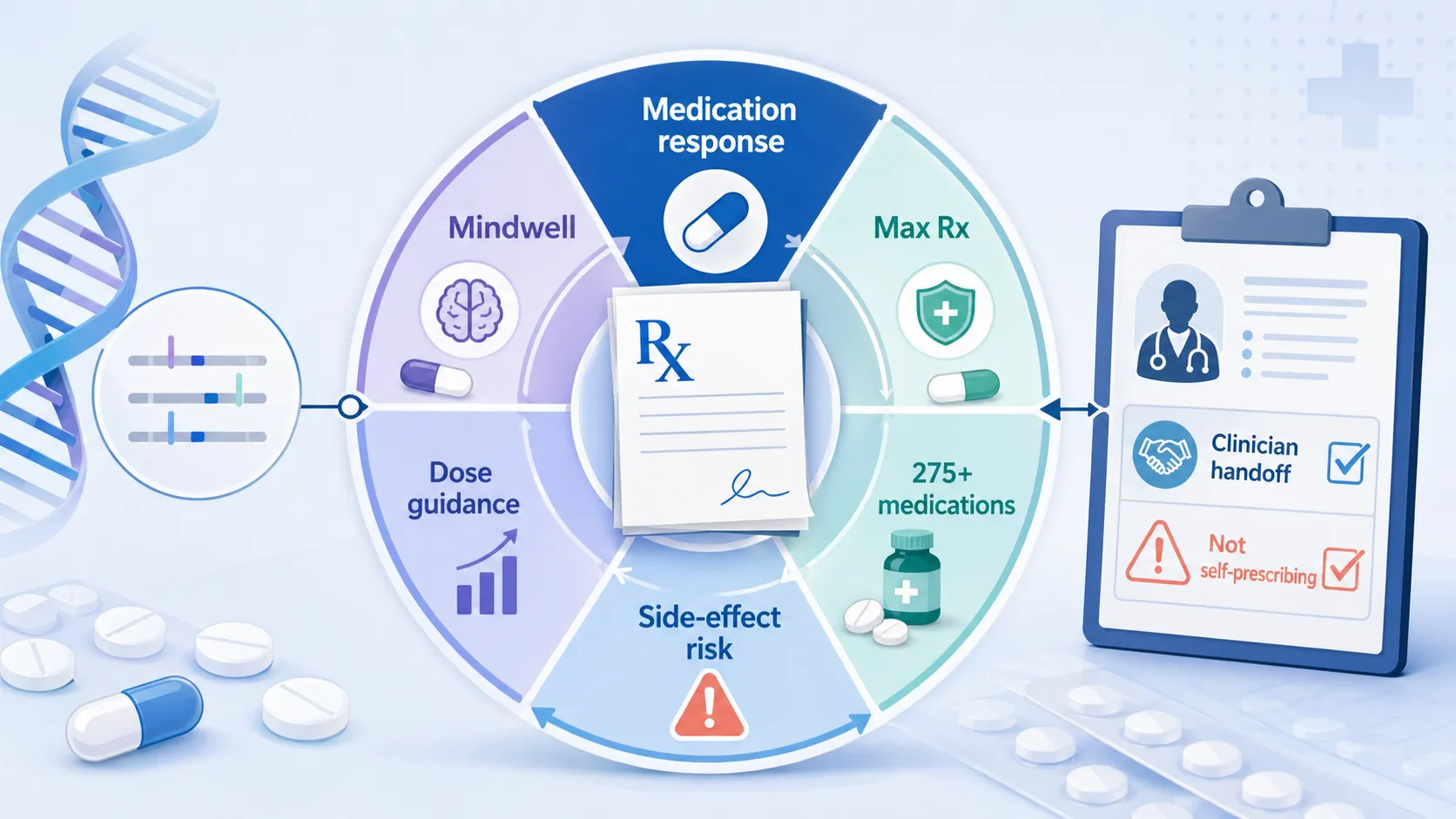
Mindwell and Max Rx read the same 39-gene panel — there is no “focused subset” versus “broader panel” distinction in the DNA tested. What changes at the Max Rx tier is the interpretation report: it expands from 120+ mental-health medications to 285+ medications across psychiatry, cardiology, pain management, endocrinology, gastroenterology, gynecology, immunology, infectious disease, neurology, oncology, and more. Only some of those drugs have actionable FDA pharmacogenomic labeling or CPIC guidance.
Cost and What’s Included
Pricing checked on ClarityX’s product pages on October 8, 2026, when the 25%-off CLARITY25 code was running as a Fall Sale ending October 12. The same code has run under a rotating sale name in every archived copy of these pages we checked since January 2025, so we list the code price first.
| Plan | Price with code | Listed price | Best for |
|---|---|---|---|
| Mindwell | $299.25 | $399 | Mental-health prescribing decisions (120+ medications) |
| Max Rx | $374.25 | $499 | Broad medication coverage across specialties (285+ medications) |
Both kits include the at-home collection device, prepaid return shipping, lab processing at a CLIA-certified, CAP-accredited facility, the patient-facing report, and review of the order by a network physician licensed in your state — no prescriber of your own is required to buy. ClarityX says every kit also includes a review of your results with your own provider: its pharmacists, who are certified in pharmacogenomics, share the report with your provider and consult with them on a medication plan. ClarityX’s concierge page describes that service without listing a price, and ClarityX told us in October 2026 that it’s included. A one-on-one session in which a pharmacist walks you through the report is separate; ClarityX’s FAQ says it “is available for an additional cost” and is booked through the patient portal after results are in.
HSA and FSA cards are accepted, and ClarityX provides an itemized receipt for reimbursement. ClarityX does not accept health insurance — its own FAQ states this plainly, including for Medicare. Every order is self-pay; if your plan covers a billed alternative like GeneSight, Tempus nP, or Genomind’s provider-ordered route, that will usually beat ClarityX’s out-of-pocket price. See ClarityX pricing for current checkout figures.
Insurance and Medicare Coverage
ClarityX settles this question directly: “ClarityX® does not accept health insurance.” That covers Medicare too — there is no direct Medicare billing path for a ClarityX kit. Every order is self-pay.
Medicare’s PGx coverage rules exist, but they apply to the modality, not to ClarityX. NCD 90.1 covers CYP2C9/VKORC1 testing for warfarin response only under coverage-with-evidence-development criteria: enrollment in a qualifying prospective randomized clinical study and fewer than five days of warfarin in the relevant anticoagulation regimen. It does not replace standard INR monitoring. Broader PGx scenarios fall under MolDX LCD L39073 (and parallel LCDs in other Medicare Administrative Contractor jurisdictions), which ties coverage to a change in therapy based on the FDA drug label, an FDA warning, or a CPIC Level A/B gene-drug interaction. Even where Medicare would pay under those policies, it pays a billing laboratory for a clinician-ordered test — and because ClarityX doesn’t bill insurance at all, a self-purchased ClarityX kit is out of pocket regardless of whether you’d otherwise qualify.
Commercial insurance. ClarityX does not bill commercial insurers either. Competitors that do bill — GeneSight, Genomind for its Medicare Part B provider-ordered test, Tempus nP, and OneOme — are the relevant comparison if you have coverage worth using.
HSA / FSA. Both kits are payable with HSA/FSA funds, and ClarityX provides an itemized receipt for reimbursement claims. Payment plans of up to four installments are also available through Shop Pay at checkout.
Self-pay. The only path for a ClarityX kit. With the 25%-off code ClarityX has run since at least January 2025, Mindwell is $299.25 and Max Rx is $374.25; the listed prices are $399 and $499.
ClarityX vs. GeneSight vs. Genomind vs. Tempus nP vs. OneOme
The PGx category has several serious consumer-and-clinician brands. The shape of the decision is usually price vs. payer footprint vs. who actually reviews the report.
| Product | Price (2026) | Panel | Coverage claim | Sample type | Ordering | Insurance posture |
|---|---|---|---|---|---|---|
| ClarityX Mindwell | $299.25 with code ($399 listed) | 39 genes | 120+ mental-health medications | Cheek swab (ClarityX’s FAQ calls it a saliva sample) | DTC; network physician reviews and authorizes | Does not accept insurance; self-pay, HSA/FSA eligible |
| ClarityX Max Rx | $374.25 with code ($499 listed) | Same 39 genes as Mindwell | 285+ medications across 20+ therapeutic areas | Same | Same DTC model | Same |
| GeneSight Psychotropic | $330 self-pay (Myriad states most patients pay $330 or less) | Psychiatric focus; PK + PD genes | Antidepressants, anxiolytics, antipsychotics, mood stabilizers, stimulants | Cheek swab | Clinician-ordered only | Strongest payer footprint in the category; $0 typical out-of-pocket on Medicare/Medicaid for eligible patients |
| Genomind PGx Test | $599 self-pay | 26 genes | 1,000+ drugs, 99%+ of commonly prescribed medications | Cheek swab | DTC via Genomind’s own licensed telehealth provider, or your own clinician | Self-pay for the at-home route; separately offers Medicare Part B coverage ($0 if criteria met) for its provider-ordered test. Includes a 30-minute genetic counselor consult |
| Tempus nP | $295 self-pay | 13 pharmacogenomic genes (NGS-based) | Psychotropic metabolism, response, and adverse-event risk | Saliva | Clinician-ordered only | Accepts government and in-network insurance; payment plans and financial assistance available |
| OneOme RightMed | $349 self-pay ($199 max out-of-pocket under its financial-assistance program) | 27 genes | 100+ medications across multiple conditions | Cheek swab (unverified at review time) | Doctor-ordered | Out-of-network with most insurers; coverage varies; HSA/FSA accepted |
ClarityX prices checked October 8, 2026. Competitor prices sourced from each vendor’s own posted pages, accessed August 21, 2026.
GeneSight is the brand to beat on insurance footprint. ClarityX wins on panel breadth at the Max Rx tier and on self-pay checkout clarity, but genotypes fewer genes than Genomind or OneOme — its edge is a bigger interpreted-drug list, not more DNA. Genomind buys the deepest self-pay panel at the highest self-pay price, with a genetic-counselor consult included. Tempus nP and OneOme both require a clinician to order, which is the trade-off for their insurance footprint.
For mental-health prescribing with GeneSight coverage, start there. For multi-specialty prescribing across cardiology, pain, or oncology without a clinician willing to order Tempus nP or OneOme, Max Rx covers more drugs per dollar.
Provider Portal and EHR Integration
ClarityX positions itself as clinician-facing, and the provider experience differs from a 23andMe-style consumer dashboard. Through the provider portal, clinicians order kits, review drug-by-drug recommendations, see dosing-modifier guidance, and flag drug-drug-gene interactions across a patient’s medication list.
The provider report shows three columns: medications in the regimen, the predicted phenotype for the relevant gene (e.g., CYP2D6 intermediate metabolizer), and a categorized recommendation. Read each recommendation through the lens of its underlying evidence: some gene-drug pairs sit on direct FDA labeling or CPIC guidance, while others are lower-evidence signals that still need clinician judgment. The patient-facing version is a simpler read of the same data.
ClarityX does not publish an Epic App Orchard or Oracle Health (Cerner) integration listing as of August 2026, and independent EHR-integration confirmation was not available at review time. Reports deliver through the ClarityX portal and download as PDF for upload to the chart. The provider-onboarding flow handles NPI verification before a new clinician orders, so confirm with your prescriber before buying a kit yourself.
Lab and Certification
ClarityX states its samples are processed at a CAP-accredited and CLIA-certified reference lab. CLIA is the federal certification floor for diagnostic labs in the U.S.; CAP accreditation from the College of American Pathologists is the standard quality layer on top. Both are baseline expectations for any 2026 PGx test. ClarityX also badges itself “HIPAA certified” on product pages — there is no such thing as HIPAA certification (HIPAA is a compliance obligation, not a certificate any body issues), so read that badge as marketing language, not a credential.
ClarityX product pages do not publish the processing lab’s name, location, CLIA number, or CAP certificate ID. The About Us page only says the company “utilizes state-of-the-art CLIA-certified and CAP-accredited laboratories” without naming them. Ask customer service for those details before purchase if you need documentation (for instance, to submit the result to a benefits administrator or clinical trial sponsor). The merchant accreditation badge alone is not a verifiable certification record.
Regulatory status matters separately from lab accreditation. ClarityX does not publish an explicit “laboratory-developed test” (LDT) statement, so that designation is unverified from ClarityX’s own site — though the inference is reasonable, since a CLIA-run PGx panel with no FDA marketing authorization typically is an LDT. What’s confirmed either way: ClarityX’s test is not FDA-approved, FDA-authorized, or FDA-cleared. The FDA’s pharmacogenomic biomarker tables apply to drug labels, not to ClarityX’s product, and the FDA has previously warned other PGx labs (Inova Genomics, April 2019) about marketing claims that go beyond what drug labeling supports.
Privacy, HIPAA, and Data Handling
ClarityX collects three categories of data: personal information at checkout, medication information at sample registration, and sample-derived genetic data from the lab. The current privacy policy (effective January 31, 2025, unchanged since our last review) states that test kits containing DNA are destroyed once genetic information is produced. On selling data, the policy is more careful than it sounds at first read: it says ClarityX / Precision Sciences “will not sell, lease, or rent your identifiable individual information to any third party without your explicit consent.” That’s a no-sale-without-consent commitment scoped to identifiable information, not an absolute promise — don’t read it as “ClarityX never sells your data.” (ClarityX’s FAQ states the no-sale point more absolutely than the policy itself does; where the two conflict, the policy governs.)
PGx data sits at an awkward legal seam, so the protections you get depend on the path:
- Clinician-ordered (HIPAA path). If your prescriber orders through the provider portal and the result enters your medical record, HIPAA covers the data as protected health information. The clinician’s practice is the covered entity, and HIPAA’s access, correction, and breach-notification rules apply.
- Direct-to-consumer (consumer-privacy path). If you buy a kit yourself and the result never routes through a HIPAA-covered clinician, HIPAA generally does not apply — even though ClarityX says it follows HIPAA requirements. Whether you actually get HIPAA’s patient rights depends on whether the result lands in a covered entity’s record, which for a self-purchased kit it may not. State-level genetic privacy laws and ClarityX’s own policy become the controlling framework.
The policy does not publish a specific retention period for your derived genetic data (only that the physical kit is destroyed once results are produced), a research opt-in or opt-out, a vendor-sharing list, or a one-click deletion right — it only says you can request deletion, with no stated turnaround. If those details matter, ask in writing before submitting your sample.
Pros and Cons
| Pros | Cons |
|---|---|
| Focused on a real prescribing problem, not generic wellness | Does not accept health insurance in any form, including Medicare |
| Max Rx’s 285+ medication report is broad vs. psychiatric-only competitors | Mindwell and Max Rx test the same 39 genes; the price gap buys report scope, not more DNA |
| Clinician network active in all 50 states; no prescriber needed to buy | Lab name, CLIA number, and CAP ID not published on product pages |
| Pharmacists review your results with your own provider, included per ClarityX | A one-on-one pharmacist session for you costs extra |
| Privacy policy commits to no-sale of identifiable data without consent | Policy lacks a retention period, deletion turnaround, or research opt-in toggle |
| At-home cheek swab, no clinic visit or blood draw; HSA/FSA accepted | Some panel markers (HTR2A, HTR2C, DRD2, GRIK4, ADRA2A, COMT, MTHFR) have weak clinical-utility evidence |
Who Should Buy It
If a ClarityX result raises questions you can’t resolve with your prescriber alone, a genetic counselor can help you weigh the lower-evidence markers on the panel against the ones with real CPIC or FDA backing. ClarityX makes the most sense for:
- patients working with a clinician on medication optimization
- people with a history of poor response or hard side effects on prior prescriptions
- buyers who want a PGx-focused product rather than a broad ancestry kit
- patients paying with HSA or FSA who want a clear self-pay path
It makes less sense for:
- anyone shopping for ancestry, traits, or wellness reports
- patients expecting a diagnosis from the report
- buyers planning to adjust their own medications without clinical input
- patients with strong commercial insurance for PGx, where GeneSight is usually cheaper out-of-pocket
FAQ
Is ClarityX legit?
Yes. ClarityX uses a CLIA-certified, CAP-accredited reference lab and operates a clinician network in all 50 states. It has no FDA marketing authorization; it runs under CLIA rather than as an FDA-cleared device, which is the standard regulatory posture for most clinical PGx products (ClarityX itself does not publish an explicit “laboratory-developed test” statement, so treat that specific label as inference rather than a claim ClarityX makes). The major gene-drug pairs on the panel are backed by CPIC guidelines and FDA drug labeling; others are lower-evidence signals. Your result is one input into a prescribing decision, not the decision itself.
What’s the actual difference between Mindwell and Max Rx?
Nothing in the DNA. Both kits genotype the same 39 published genes. Mindwell’s report interprets that genotype against 120+ mental-health medications; Max Rx’s report interprets the same genotype against 285+ medications across 20+ therapeutic areas. You’re paying the extra $75 for a broader drug report, not a bigger panel.
How much does ClarityX cost in 2026?
Mindwell is $299.25 and Max Rx is $374.25 with ClarityX’s 25%-off CLARITY25 code, which has run under a rotating sale name in every archived copy of its product pages we checked since January 2025. The listed prices are $399 and $499. HSA and FSA cards are accepted.
Is ClarityX covered by insurance?
No. ClarityX states plainly that it does not accept health insurance, including Medicare. NCD 90.1 and LCD L39073 govern Medicare’s coverage of PGx testing in general — NCD 90.1 covers CYP2C9/VKORC1 warfarin testing only under coverage-with-evidence-development criteria, and LCD L39073 covers broader clinician-ordered, billed testing — but neither creates a path to Medicare paying for a self-purchased ClarityX kit, because ClarityX doesn’t bill any insurer at all.
Is the pharmacist consult included?
Partly. ClarityX says every kit includes a review of your results with your own provider: its pharmacists, who are certified in pharmacogenomics, share your report with your provider and consult with them on a medication plan. A one-on-one session in which a pharmacist walks you through the report is separate; ClarityX’s FAQ says it “is available for an additional cost” and is booked through the patient portal after your results are in.
ClarityX vs. GeneSight: which is better?
GeneSight has the longer payer footprint. If your insurer covers it, GeneSight usually lands at a lower out-of-pocket cost for a mental-health decision, but it requires a clinician to order it. Without coverage, Mindwell at $299.25 with the code costs a little less than GeneSight’s $330 self-pay option. ClarityX Max Rx covers a wider drug list at a clearer self-pay checkout, which matters more if your medication question spans cardiology, pain, or oncology and you don’t have a prescriber willing to order a competitor.
How long do ClarityX results take?
Typically 5 to 10 business days after the lab receives the sample for Mindwell and Max Rx. Outbound shipping adds another 3 to 6 business days.
Bottom Line
ClarityX is a credible self-pay pharmacogenomic test. The biggest thing to understand before buying is that Mindwell and Max Rx read the identical 39-gene panel — the $75 gap between them buys a broader medication report, not more DNA. The lab is CLIA-certified and CAP-accredited, though ClarityX doesn’t publish the lab’s name or CLIA number, and it does not accept insurance of any kind. The ceiling is the same as every PGx test: the report only helps as much as the prescribing conversation that follows it.
If you have a clinician ready to use the results, Mindwell at $299.25 with the code is a fair price for a psychiatry-focused report, and Max Rx at $374.25 covers the wider medication list on the same panel. If your insurance covers GeneSight, Tempus nP, or a provider-ordered Genomind test, run those numbers first — they’ll usually beat ClarityX’s self-pay price. Whatever you buy, do not self-prescribe off the report.